Are you one of the many renters thinking about where you’ll live the next time your lease is up? Before you decide whether to look for a new house or another apartment, it’s important to understand the true costs of renting in 2022.
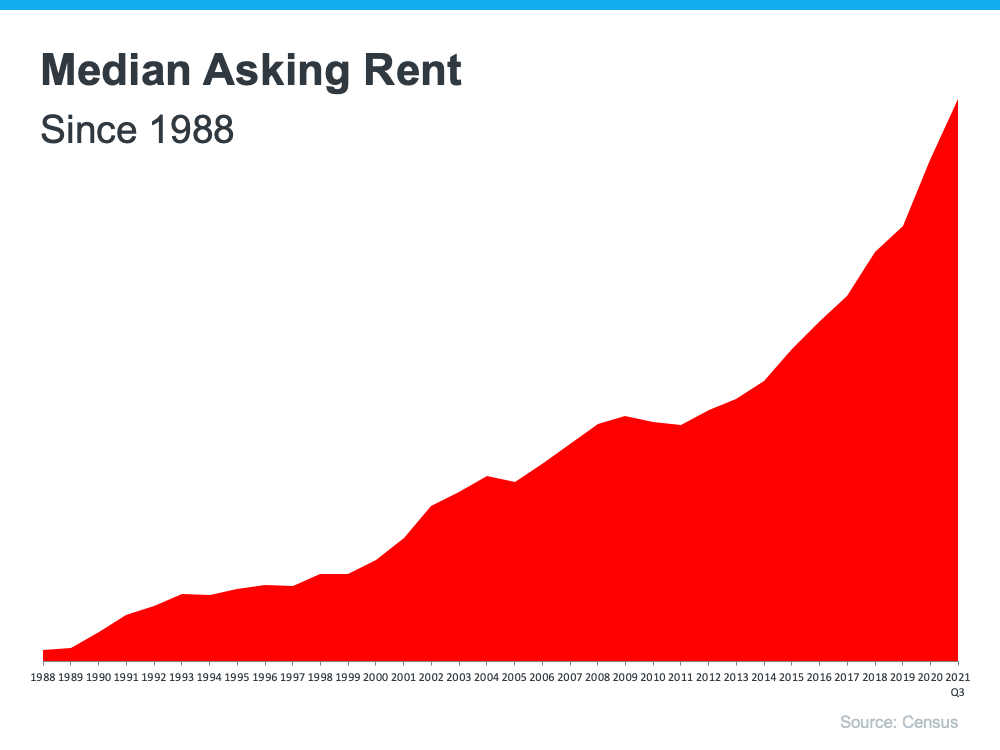
As a renter, you should know rents have been rising since 1988 (see graph below):
In 2021, rents grew dramatically. According to ApartmentList.com, since January 2021:
“. . . the national median rent has increased by a staggering 17.8 percent. To put that in context, rent growth from January to November averaged just 2.6 percent in the pre-pandemic years from 2017-2019.”
That increase in 2021 was far greater than the typical rent increases we’ve seen in recent years. In other words – rents are rising fast. And the 2022 National Housing Forecast from realtor.com projects prices for vacant units will continue to increase this year:
“In 2022, we expect this trend will continue and fuel rent growth. At a national level, we forecast rent growth of 7.1% in the next 12 months, somewhat ahead of home price growth . . .”
That means, if you’re planning to move into a different rental this year, you’ll likely pay far more than you have in years past.
Homeownership Provides an Alternative to Rising Rents
If you’re a renter facing rising rental costs, you might wonder what alternatives you have. If so, consider homeownership. One of the many benefits of homeownership is it provides a stable monthly cost you can lock in for the duration of your loan.
As Lawrence Yun, Chief Economist at the National Association of Realtors (NAR), says:
“. . . fast-rising rents and increasing consumer prices, may have some prospective buyers seeking the protection of a fixed, consistent mortgage payment.”
If you’re planning to make a move this year, locking in your monthly housing costs for 15-30 years can be a major benefit. You’ll avoid wondering if you’ll need to adjust your budget to account for annual increases.
Homeowners also enjoy the added benefit of home equity, which has grown substantially right now. In fact, the latest Homeowner Equity Insight report from CoreLogic shows the average homeowner gained $56,700 in equity over the last 12 months. As a renter, your rent payment only covers the cost of your dwelling. When you pay your mortgage, you grow your wealth through the forced savings that is your home equity.
Bottom Line
If you’re thinking of renting this year, it’s important to keep in mind the true costs you’ll face. Let’s connect so you can see how you can begin your journey to homeownership today. Call us today!
CHRISTINE ALMARINES
714-476-4637 | @carealestategroup.com
christine@carealestategroup.com
Realtor DRE 01412944
MICHELLE KIM
714.253.7531 | @michellejeankim_homes
michelle@carealestategroup.com
Realtor DRE 01885912
CA Real Estate Group | Keller Williams Realty Anaheim Hills/Yorba Linda
What is is about a deep clean that makes us feel like we really have our lives together?
I’m a firm believer in getting your new year off to a good start, which involves leaving all the clutter and mess back in 2021. Let’s explore the top things you need to declutter and organize before the midnight champagne toast, because 2022 is going to be YOUR year!
1. Your Files
It’s a good idea to keep all of your important documents and files in one place, both for organization and easy access in case of an emergency. Certain documents should live here forever — things like your birth certificate and passport. Others you can hold for some time, but toss after a few years like old apartment leases. Make sure to shred any documents with sensitive information like your social security or bank account numbers.
2. Your Refrigerator
Be honest: when was the last time you saw the very back of your fridge? Even if you do a weekly grocery shop, there are probably spills and forgotten condiments taking up space out of sight.
Begin by pulling everything out of your fridge and tossing anything that’s empty or past its expiration date. Next, wipe down the shelves and inside your drawers to get rid of old stuck-on food and funky smells. Replace all your food, and finish with an open box of baking soda or used coffee grounds to help absorb any odors.
I always purchase clean white towels and linens because you can toss them together for a bleach load to keep them clean and fresh. I realized I hadn’t actually purchased new bath towels since college (gross), so decided to splurge on some new ones. While my old towels were still fine, I couldn’t believe how dingy and worn-out they looked compared to my new, fluffy towels! Take a tour through your linen closet; if you can’t remember the last time you bought new sheets or hand towels, it’s probably time to invest in a fresh set. Consider donating any towels that are still in relatively good shape to your local animal shelter (they always need towels!) when you stock up on new ones.
4. Sneaky Areas of Your Home
You probably regularly sweep the floors and do your dishes, but when was the last time you gave your baseboards a good wipe-down? Giving the nooks and crannies of your home a good clean is good for your health and your sanity.
Some areas that could probably use a once-over include:
The only time I ever open my medicine cabinet is to grab floss or Advil. Chances are you have some expired medications on the high shelves that are taking up space. It’s important to dispose of old medication properly. The FDA recommends disposing properly of medication or dropping off any unused or expired medications at a take-back location, so check where the nearest one to you is located.
6. Kitchen Cupboards
Is there an unused ice cream maker sitting in the back of your cabinets that was gifted to you by a well-meaning aunt? Probably. Let’s face the music: you’re never going to use that waffle maker/baked potato cooker/panini press. Donate any appliances that still work and toss anything that’s broken/missing parts. This includes old cracked cups, Tupperware without lids, and grungy baking sheets.
Clean car, clean mind! (That’s the saying, right?) Your car is another black hole area where things disappear into a dark void, never to be seen again. A deep car clean isn’t something you can do on your commute to work, so make sure to carve out a little time to dive in.
Begin by opening all your car doors so you can peek under the front chairs and between the seats. There’s almost a 100 percent chance there’s at least one lip balm down there. Toss any garbage, and run any clothes/shoes/yoga mats you’ve left in there back into the house.
Many car washes and gas stations have vacuums you can use to suck up crumbs if you don’t have a cordless vacuum on hand. Don’t forget a quick sweep of the trunk! If you’re feeling really empowered, finish off with a car wash and new air freshener.
For those who enjoy outdoor activities, today I present you with the best easy hikes in Orange County.
With the sheer amount of breath-taking landscapes and amazing parks, getting out in Southern California is more than a pleasant experience.
Hiking in Orange Country is simply amazing, from easy flat trails to sloppy mountain hikes, and scenic viewpoints, you have a plethora of options to break the monotonous city life.
Whether you’re hiking alone or hanging with family and friends, I have compiled a list of what I consider some of the best easy hiking trails in Orange County.
Table of Contents
ABOUT THESE HIKES
Let me start the article by saying that I love to walk/hike but I am not an experienced hiker.
I do not own professional gear, have not done long backpacking trips, and am not in the best of physical shapes.
However, I believe Orange County has something for everybody when it comes to walking and hiking. I have picked these hikes because I have personally done them. If I have been able to complete them, a good number of people can complete them too.
So, whatever your condition, I want to encourage you to go out and tackle one of these Orange County hikes. Bring the family or a group of friends. Remember to take it easy. There is no reason to rush.
Important Notes: I recommend checking OC hiking trails status before heading to a particular place. Trails can get closed due to weather conditions (rain, fire) or other causes (mountain lion activity).
HIKING GEAR
Here are some suggestions on how to get ready to tackle the different hiking trails in Orange County.
Hiking Shoes – Wearing the right shoes is essential when hiking. I recommend investing in a good pair. Merrell shoes have always been good for my crooked feet. Not long ago, I was using tennis shoes to hit the trails. That was until I hurt my left foot. Since then, hiking shoes have done wonders for me. >Check out my hiking shoes
Hiking Socks – Wool hiking socks provide support, cushion, and prevent blisters. EnerWear sells an excellent 4-pair set for a good price. >Check them out here
Insoles – Insoles are another way to protect your feet when hiking. They do a great job absorbing shock. Walk Hero’s insoles have some of the best ratings in the market. >Get them here
Crossbody Bag – I take the minimum with me when I go on trails. I keep everything organized in a small Herschel crossbody bag. >Buy this great crossbody bag here
Hiking Poles – Hiking poles are lifesavers on trails with an incline (more if you have wobbly knees). TrailBuddy’s trekking poles are such a great help. >Check these hiking poles
Sun Block – Do not leave the house (or the car) without applying sunblock. I repeat, always wear sunblock when outdoors. >Buy sun block here
Wide Brim Hat – A wide brim hat is a great way to protect your scalp, face, and neck. The ones manufactured by FURTALK come with an anti-UV function. >Buy this amazing hat here
Sunglasses – These are another must when it comes to protecting from the sun. A polarized, sporty pair works better for hiking. >Take a look at this wonderful pair
Water Bottle – Do not forget to bring water! Keep yours cold by taking a beautiful Hydro Flask water bottle. >Check out the insane options her
Snacks – It is a good idea to carry snacks such as granola bars, protein bars, trail mix, nut, and jerky
Camera – I have never gotten used to taking pictures exclusively with my phone. I prefer to use the Sony Alpha a6000. It is compact and takes gorgeous pictures. >Buy Sony Camera here
EASY HIKES IN ORANGE COUNTY
Let’s get to the fun part of the article. Below, I have details about each chosen hike including location, distance from Downtown Anaheim (for reference), special notes, and ideas on where to head after the hikes. And, I am calling these hikes but some of them are better described as walks.
The focus of this article is easy trails but I will provide info about moderate and/or difficult trails in the places described below.
Oh, and there are so many hiking trails in Orange County! It was difficult to determine which ones to include in the article. If I do not cover your favorite OC hike, let me know in the comments section below.
SANTIAGO OAKS REGIONAL PARK
Location: Orange (Yes, there is a city called Orange in Orange County)
Distance from Anaheim: 13 miles
The Santiago Oaks Regional Park sits on a vast 1269-acre swath of land. This beautiful landscape provides a refreshing escape from the noisy city life. It’s actually a whole new world with an abundance of wildlife and mature forest including shady groves.
The Santiago Oaks Regional Park is a preferred destination for those who genuinely love nature. It’s a powerful magnet for hikers, bikers, and horse riders, thanks to the gorgeous vistas, a creek that gently curves through the wooded areas, and interconnecting foot-trails.
Easy trails include the Arizona Crossing Trail (0.04-mile), Bobcat Meadow Trail (0.28-mile), Lady Bug Trail (0.04-mile), Pony Trail (0.17-mile), Rinker Grove Trail (0.31-mile), Sour Grass Trail (0.09-mile), Towhee Trail (0.08-mile), Wilderness Trail (0.48-mile), Willows Trail (0.85-mile) and Winders Trail (0.19-mile). All of these trails are multi-use.
The Historic Dam Trail is considered easy as well but only people on foot are allowed.
The park has moderate and difficult trails for those who want to take things to a different level. In addition, you can connect to the Anaheim Hills Trail System.
Park’s maps can be obtained onsite or online. Make sure to visit the nature center to learn about the area’s history, fauna, and flora.
Parking is $3 fee on weekdays and $5 on weekends.
Where to Go After the Hike: Downtown Orange or Downtown Disney (free)
PETERS CANYON REGIONAL PARK
Location: Orange
Distance from Anaheim: 15 miles
The Peters Canyon Regional Park comprises 340-acres of grasslands, marsh, and coastal sage scrub. Since within the park limits you can find the Upper Peters Canyon Reservoir, it is easy to observe different species of birds all year round.
One of the main attractions in the park (and on the OC trails system) is the Lake Valley Loop, a 2.5-miles, easy trail offering panoramic views of the reservoir. From the Lake Valley Loop, you can connect to the East Ridge View Trail and the Peters Canyon Trail and basically loop around the entire park. Keep in mind the East Ridge View Trail has a difficult rating.
These trails are multi-use, meaning that hikers, bikers, and horse riders are welcome.
Where to Go After the Hike: Downtown Orange or Downtown Disney (free)
BOLSA CHICA ECOLOGICAL RESERVE
Location: Huntington Beach (technically this reserve is located in state land and does not fall within the limits of the City of Huntington Beach)
Distance from Anaheim: 24 miles
If your favorite pastimes include bird watching and photography, then the Bolsa Chica Ecological Reserve is the ideal relaxation place for you.
The Reserve, protecting freshwater and saltwater marsh, sits on 1300+ acres of land and it is home to over 200 bird species. It is a favorite spot for migratory birds. This wildlife-dense wetland is located just a few miles from Downtown Huntington Beach. Believe me when I say this is a great family destination.
It features a 4.5-mile network of trails. The reserve can be accessed from the Pacific Coast Highway. The exact address is 18000 CA-1. If you enter the name of the reserve or the exact address on a GPS, you will be taken to a parking lot from where you can start to walk the 1.5 mile Loop Trail (or Inner Bay Loop Trail). From this trail, you can extend your walk by connecting to other trails.
A second entry point is through the Bolsa Chica Conservancy Building or Interpretative Center (3842 Warner Avenue). You can learn all about the flora, and fauna of this coastal wetland. Then, you can explore the area by hitting the Mesa Trail. It is about 0.6 miles (one way) to the Mesa Trail Overlook. From the Overlook, you can continue to walk around the Bolsa Pocket or connect to the Loop Trail.
Dogs are not allowed on the trails.
Where to Go After the Hike: Bolsa Chica State Beach, Sunset Beach, or Downtown Huntington (to check out the pier, museums, eateries, or Pacific City).
Talking about beginner hikes in Orange County, we cannot forget to mention the Badlands Park Trail (some people may call this trail the Seaview Trail because of a nearby park and trail).
It will take you just about 45 minutes to complete this scenic loop that snakes behind a residential area and affords breathtaking views of the southern Laguna Beach coast and Dana Point.
The trailhead can be found at 31671 Isle Vista. The 2.3-mile trail (roundtrip) is very easy to walk and offers ocean views along the way. The trail is heavily trafficked, so expect to have others around. Try to hike during the week to avoid crowds.
Furry friends are welcome on the trail but must be kept on a leash.
Where to Go After the Hike: Treasure Island Park (one of the most gorgeous places in Laguna Beach), Aliso Beach, or Salt Creek Beach
BACK BAY LOOP
Location: Newport Beach
Distance from Anaheim: 18 miles
Upper Newport Bay is a great place for nature and bird lovers. It attracts over 35,000 migratory birds during winter, and it’s home to 6 endangered bird species. Moreover, the Bay offers access to bluff vistas, scenic spots, and several educational facilities.
The Newport Back Bay Loop, a 10.5 miles long trail, allows visitors to experience this ecosystem. Before you start screaming, no, I am not suggesting you complete this loop in one sitting.
There are multiple entry points. You can complete different sections at different times. Actually, this is what makes the Back Loop one of the top hiking trails in Orange County. You can walk it 3 or 4 times and see something new on every occasion.
The park is completely free and dogs are allowed.
The Back Bay Loop connects to the Mountain to the Sea Trail. You can walk from here to Peters Canyon Regional Park.
Where to Go After the Hike: Balboa Peninsula, Balboa Island, Fashion Island, or Corona del Mar
Within the Whiting Ranch Wilderness Park, there is an area containing red rock formations. I know these are not necessarily associated with California but we have some.
From the parking lot off Market Place Street (keep in mind there are several parking lots in the park), take the Borrego Canyon Trail (about 1 mile) and connect to the Red Rock Canyon Trail (you have to pass through Mustard Road).
Even though most people visit the park to see the red rocks, there are about 17 miles of trail within the property. There are other easy trails that can be started from the Glenn Ranch Road parking lot.
Where to Go After the Hike: Irvine or Laguna Beach
BLUFF TRAIL AT CRYSTAL COVE STATE PARK
Location: Newport Beach and Laguna Beach
Distance from Anaheim: 24 miles
Crystal Cove State Park is huge (3,936 acres). The park comprises 3.2 miles of beach (in a natural state) where sunbathing, swimming, surfing, diving, and tide pooling are permitted. In addition, there are 2,400 undeveloped acres of land ideal for backcountry hiking and primitive camping.
This is my top pick on this list. If you can only visit one hiking area in Orange County, make it Crystal Coast. I am convinced this is one of the most beautiful parks in California.
The 3-mile Bluff Trail hugs the coast and offers crazy beautiful views of the Pacific Ocean. There are multiple entry points to the trail. You do not have to walk the 3 miles if you do not want to. The entire trail is unshaded, so may want to take your sunscreen along with a bottle of water and probably a hat too.
After hiking, make sure to check the beach cottages at the Crystal Cove Historic District, the tide pools, and the shakes prepared at Ruby’s Shake Shack (because we all need a shake after hiking).
The park deserves the entire day (or most of the day). Make arrangements accordingly.
Where to Go After the Hike: I recommend enjoying the park for the day. If you want to keep exploring the area, you can stop by Corona del Mar, the Balboa Peninsula or Heisler Park in Laguna Beach (another top pick).
The Buck Gully Reserve can be seen as a long green belt located in the seaside neighborhood of Corona del Mar. The Reserve is completely surrounded by residences. The trailhead can be found at 872 Poppy Avenue. Park on the street.
The Bulk Gully Trail is about 5.2 miles long. It is a fairly easy trail with just enough incline for a good workout.
Be ready to spot wildflowers, insects, birds, and small mammals. For a little more challenge, you can try the shorter but steeper Bobcat Trail. Dogs are not allowed, but you can have a good outdoor time with your kids.
There are no facilities onsite. Bring enough water and have a bathroom break before heading to the trailhead.
Carbon Canyon Regional Park is a favorite among locals because of its lake, fishing piers, sporting facilities, grassy fields ideal for picnics, and scenic trails.
The showstopper in the park is the 3-acre Redwood Groove (the only one in Orange County). This area is accessed through the 1.1-mile Redwood Trail. Do not miss the redwoods if you visit!
Other easy trails in the park include the Carbon Canyon Creek Nature Trail and the Bell’s Vireo Trail. In total, there are about 2.5 miles to enjoy.
Other amenities include volleyball courts, tennis courts, playgrounds, paved biking paths, baseball fields, horseshoe pits, a native garden, and picnic pavilions.
The parking fee is $3 on weekdays and $5 on weekends.
Where to Go After the Hike: There is enough to do in this park for an entire day. There are more hiking opportunities at the adjacent Chino Hills State Park.
QUAIL HILL TRAIL – ORANGE COUNTY TRAILS
Location: Irvine
Distance from Anaheim: 20 miles
Quail Hill Trail is a 2-mile loop hike located at the Irvine Open Space Preserve. This trail is easy enough for beginners and offers a relaxing walk through native grassland. It has a slight incline which is simple to tackle by kids, bikers, and joggers.
The trailhead is located at 34 Shady Canyon Drive. Free parking is available at this spot.
Other trails in the Irvine Open Space Preserve include the Bommer Meadow Trail, Nature Loop Trail, and Bommer Pass Trail. The Quail Hill and Bommer Canyon trailheads are connected by the Shady Canyon Bikeway. You can drive between the two areas (since there are about 3 miles between them).
Also, it is possible to connect to trails in the Laguna Coast Wilderness Park.
Where to Go After the Hike: Irvine, Newport Beach, or Laguna Beach
TOP OF THE WORLD – HIKES IN ORANGE COUNTY
Location: Laguna Beach
Distance from Anaheim: 30 miles
As the name implies, the Top of the World Trail leads to panoramic views of the Pacific Ocean, hills, canyons, Catalina Island, and even Mt Baldy.
The trailhead can be found at 580 Canyon Acres Drive. Park on the street. Let me warn you this is a steep trail leading up (about 1 mile, 2.4 miles round trip).
Now, I have included this trail here because you can “cheat” to make it to the top. All you have to do is drive to Alta Laguna Park. From there, you can access the trail (from the top) and walk as much as you want. Just keep in mind that the longer you go down, the harder is going to be to go back to the top.
You may have to bring some water, a hat, a hiking pole, and sunscreen. From here, you can connect to the West Ridge Trail (Moderate) and Dripping Cave Trail (Moderate).
Where to Go After the Hike: Heisler Park or Treasure Island Park for incredible coastal views
RONALD W. CASPERS REGIONAL PARK
Location: San Juan Capistrano
Distance from Anaheim: 40 miles
Ronald W. Caspers Regional Park protects 8,000 acres of coastal oaks, sycamores, grassland, streams, and valleys.
Easy trails include the West Ridge Trail (2.27-miles), Juaneno Trail (2.68-miles), and Mesa Loop Trail (1-mile). As you can see, there are plenty of options when it comes to family-friendly hikes.
The options become even more varied when you take into consideration the moderate and difficult trails in the park. A map can be found online or onsite.
If camping is your thing, you can try to secure a spot in the park. This is one of the rare places where you can camp inland in Orange County (I am referring to public facilities). An equestrian campground is available as well.
Where to Go After the Hike: Mission San Juan Capistrano and/or Old Town San Juan Capistrano
The Dana Headland can be seen for miles. Therefore, it makes total sense to explore this natural landmark.
The Dana Point Preserve, the actual land above the headland or promontory, is part of the Headlands Conservation Area Trail System. The trail around the preserve is one mile long. There are several viewpoints along the way. You can access the trail by parking at the Nature Interpretive Center.
Now, you can connect to other parks in the trail system. For example, the loop connecting the Dana Point Preserve, Harbor Point Conservation Park, and Hilltop Conservation Park is 1.5 miles long and rated moderate.
A 2.5 miles loop (rated moderate too) goes through all the places mentioned above plus the Strand Vista Park, Strands Beach, and South Strand Conservation Park.
As you can see, there are many options when it comes to this area.
This is another of my top recommendations when it comes to Orange County Hikes. I am so in love with Dana Point!
Where to Go After the Hike: Strands Beach, Salt Creek Beach, the Harbor (for water activities, sailing, whale watching cruises, eating, and shopping), or Doheny State Beach
The Beach Trail is one of my favorite walks in Orange County In my opinion, this is one of the best coastal walks in Southern California. From the trail, you can see the Dana Point Headland, San Mateo Point, and the north shoreline of San Diego County.
This 2.3 miles (one-way) easy trail goes from North Beach to Calafia. Here are some ideas on how to tackle this OC trail:
Park at North Beach and walk all the way to Calafia. You can stop in the Downtown/Pier area for a break. This is a 4.6 miles round trip walk
Park at North Beach and walk to the Pier (1 mile, one way)
Park at Calafia and walk to the Pier (1.3 miles, one way)
Park at one of the Pier lots and walk north or south
Where to Go After the Hike: Downtown San Clemente, Trestles, San Onofre, or San Juan Capistrano
It has been incredible to share with you some of the best hikes in Orange County. Happy hiking!
❄🏡 If you’re thinking about selling your house, you don’t need to wait until the spring. BUYERS ARE READY NOW. Let’s connect to discuss why selling this post-holiday season could be the gift that keeps on giving.
We’ve all been there—barely surviving the morning rush hour of making lunches, signing permission slips, and searching for matching socks. Then after a busy day at work and school comes the evening whirlwind of homework, dinner, and maybe a few minutes of downtime.
That leaves most of us with no time to keep our home tidy, much less clean.
But if your New Year’s resolution is to have a house that doesn’t send you into a shame spiral when friends drop by, read on for our dirty … er, clean dozen: simple, quick habits that will make it look like someone slaved over your house all day.
1. Keep cleaning supplies handy where you use them
Face it: There’s no way you’re going to trek downstairs to grab some cleaner to wipe off that toothpaste glob; you’re going to leave it there until it hardens into cement. That’s why Laura Smith, founder of All Star Cleaning Services, keeps a spray bottle of all-purpose cleaner and a stack of cleaning cloths under all her sinks in the bathrooms and kitchen, so she can wipe up any little spot or spill she sees before it becomes a big mess that requires elbow grease—and time.
2. Clean the shower while you’re showering
You’re standing there rinsing your hair, so why not do a once-over of the shower walls? Smith finds one of the best products for keeping the shower clean is natural dish soap, because it is designed to fight grease—which, surprise, is mostly what’s in the soap scum lining your shower walls!
“Give the walls a quick once-over with soap and a sponge a couple of times a week, then use the showerhead to rinse, and continue on with your shower,” she says. And always wipe down those glass doors when you are finished to keep streaks at bay.
3. Clean as you cook
This is the best way to avoid a huge headache at the end of a meal, which you know you’re going to want to walk away and leave, says Janice Stewart of Castle Keepers House Cleaning. Even if you need to keep both eyes on the burners, at least fill your sink with soapy water and stick the pots, pans, utensils, and other cooking items in to soak while you eat.
4. Run the dishwasher at night
Yes, even if it’s not quite full. That’s so you can empty it first thing in the morning so it’s ready for action.
“Train your whole family to put dishes directly in the dishwasher, which keeps the sink clean and the counters clutter-free,” Smith says.
5. Embrace spot cleaning
Remember that it’s the whole chore that will wear you down, so deal only with what absolutely has to be taken care of that moment.
“One fingerprint on the door of the fridge is not a reason to clean the whole fridge,” Stewart says.
6. Keep surfaces clear
“Flat surfaces collect clutter like a paperclip to a magnet,” says Jessica Samson, spokesperson at The Maids.
They’re also what you see as you scan the room, so when you have clutter on flat surfaces it seems like it goes on forever.
“The more you can keep tables, floors, beds, and countertops clear, the cleaner and more spacious these areas feel,” she says.
The biggest clutter culprit is paper, so don’t let it pile up. Recycle unnecessary mail the minute it comes in, and create a filing system for the rest of it.
7. Clean out your refrigerator every week
Grab those sad celery stalks that you were so sure you were going to stir-fry and those takeout leftovers that never made it to the office, and trash them before they rot and leave a lingering order, advises Dawna Boone, owner of Valet Maids.
The best time to clean out the fridge is on trash day—off it goes—and ideally, right before you go food shopping to replenish it. You’ll be able to put away the groceries more easily—and you’ll be more liable to eat them if you can see them.
8. Never leave a room empty-handed
If you’re going upstairs, take something with you, whether it’s a stack of clean laundry or toilet paper refills. If you’re heading from the living room to the kitchen, grab that magazine that needs to be recycled and the water glass destined for your empty dishwasher.
9. Have a place for everything—and keep it there
Always put things back in their proper place after every use, says professional organizer PalomaBaillie.
“Dirty clothes go in the hamper—not on the floor—and clean clothes belong in your dresser and/or closet—not left in the laundry room or piled on the bed.”
Ditto for scissors, pens, and all those wayward objects that should have a designated spot in the junk drawer, as well as shoes, umbrellas, and coats that need dedicated hooks and bins to keep the entryway pristine.
10. Finish the day with a 10-minute tidying session
For those things that weren’t part of suggestions 8 and 9, make a nightly pickup part of your routine, advocates Devoreaux Walton, a lifestyle expert at The Modern Lady.
Set aside just 10 to 15 minutes every night—put on music if it makes the process more fun—and return everything to its spot, from toys to magazines. If you have a few minutes left over, run a cleaning cloth over counters or do a quick sweep, devoting five minutes to a different area every night.
11. Purge
This is more of a long-term solution, because less stuff means less to clean and organize. Use what Baillie calls her “three-bucket method,” where you keep buckets or bins handy to deal with items on an ongoing basis.
“Trash it if it’s worn out or broken; donate it if you no longer need it, but it’s otherwise usable; sell it if it’s in good condition,” she says.
If it’s hard to part with certain items, Samson recommends moving them at least temporarily to a box in the attic or a storage space. You’ll find it easier to keep up with laundry and closet organization when you have less stuff.
12. Buy a robotic vacuum cleaner
This might seem like cheating, but it’s really not.
“It is absolutely the best money you can spend if you want to keep a clean home but have pets or small children,” Smith says.
She recommends programming it to run daily while you are at work, or overnight—and then you can enjoy clean floors without lifting a finger.
What does the coming year hold for the housing market? Here’s what experts project for 2022. Mortgage rates are projected to rise and so are home prices. Experts are forecasting buyer demand will remain strong as people try to capitalize on rates and prices before they climb, creating another strong year for home sales. Let’s connect so you can make your best move in the new year.
📞 Call us today!
CA REAL ESTATE GROUP powered by Keller Williams Realty
Now that January is just around the corner, we present to you ten resolutions for your home this year, in the perfect spirit of new beginnings. They say home is where your heart is but a lovelier, better organized, and more comfortable place to live will surely work wonders.
CA REAL ESTATE GROUP powered by Keller Williams Realty
Christine Almarines @carealestategroup
Realtor DRE # 01412944
714-476-4637 | christine@carealestategroup.com
Michelle Kim @michellejeankim_homes
Realtor DRE # 01885912
714-253-7531 | michelle@carealestategroup.com
For more home maintenance and real estate tips, follow us on FB/IG @carealestategroup
A couple of years ago I went on a search for Basil Hayden’s Bourbon; it had been highly suggested as the bourbon of choice for this amazing stuffing. Sadly I was unsuccessful in my efforts to locate it in Denver and managed to make do with another brand but I will never forget that recommendation from a friend. When I was asked if I would like to recreate the Basil Hayden’s Holiday Spice Cocktail created for the brand by Joaquín Simó who was just named Bartender of the Year at the industry Tales of the Cocktail Convention held each year in New Orleans, how could I say no?
The recipe for this remarkable bourbon dates back to 1796, when Basil Hayden himself was a master distiller. Hayden was born and raised in Maryland, where he learned to make whiskey from rye. When he came to Kentucky, Hayden began making whiskey from a base of corn, but added a higher percentage of rye than other distillers, resulting in a smooth, mild bourbon that was distinctly his own. The abundance of rye gives it a slightly peppery taste and aroma, perfect for sipping on the rocks but also delicious in a well crafted cocktail.
Aged eight years at a relatively mild 80 proof, Basil Hayden’s has a very broad appeal. The Spirit Journal has said, ‘Basil Hayden’s is one of the best ultra-premium bourbons that you can find. It’s a good example of what a classic bourbon is like. It’s absolutely brilliant.” It’s all true; this is one fine bourbon. I couldn’t help but love the packaging too; check out that metal and copper stamped band that encircles the bottle. Very cool indeed.
Partnering with Basil Hayden’s, Joaquín has created the quintessential holiday cocktail. The Basil Hayden’s Holiday Spice combines the bourbon’s spicy finish with the winter flavors of maple syrup and cinnamon. Joaquín’s expert mixology skills make the cocktail the perfect addition to any holiday party, or a low-key fireside evening. For Mr. Simó, it’s been an unlikely journey from his native Ecuador to the accolades at the Tales of the Cocktail convention. After finishing his degree in English literature and comparative religion at Boston University he found himself working dive bars and rock ‘n’ roll joints before moving to New York eight years ago where he polished his craft.
Known not just for being a master mixologist, Simo’s engaging manner and eagerness to discuss a wide range of topics with patrons shows a genuine hospitality; combined with his skills with a shaker and jigger make this a most relevant accolade. I was excited about this cocktail for a couple of reasons beyond the bourbon too. The ingredients seemed to sing on paper; how could they not be fabulous mixed together? A great bourbon mixed with lemon juice, maple syrup and cinnamon with just a touch of Amaretto and bitters? I knew I would love it before the first taste and I was right. As much as I do enjoy some specialty cocktails over the holidays; many are sweet concoctions and I was so ready for a big girl drink!
I love that this is a great cocktail for all winter long…maybe someone will gift you a bottle of Basil Hayden’s for the holidays..I sure hope so! CHEERS!
SERVES 2
BASIL HAYDEN’S HOLIDAY SPICE COCKTAIL
10 minPrep Time
10 minTotal Time
Ingredients
4 oz Basil Hayden’s Bourbon
1 & 1/2 oz Fresh Lemon Juice
1 oz Maple Syrup
1/2 oz Amaretto
6 dashes Angostura bitters
Instructions
Combine Basil Hayden¹s, lemon juice, maple syrup, Amaretto and bitters in a mixing tin with ice and shake vigorously.
Strain into a rocks glass over fresh ice.
Grate a cinnamon stick over the top and add the stick to the cocktail as garnish.
🐶 It’s no secret that we love our furry friends – about 70% of U.S. households have pets. What may come as a surprise is how large a role they play in the homebuying process.
🐱 Americans spend $1,163 a year on their pets, and nearly half of pet owners say they would move for better accommodations and amenities for their pets.
🐰 If you’re thinking of adding a furry friend, or if you already have, let’s connect to discuss how you can find a home that meets all your pet’s needs.
It’s a Catch-22 homeowners are all too familiar with: Remodeling your outdated kitchen is almost certain to pay off big when you sell—but the actual makeover takes big bucks.
Is there any way to make a huge change without all the expense? Well, believe it or not, you can give your kitchen a face-lift without ripping out everything and starting from scratch. Yes, it all comes down to being creative with your cabinets—uppers, lowers, and everything in between.
Here’s some savvy advice from the pros who know, along with excellent cheap and simple cabinet updates you can start—and finish—this weekend.
You can’t go wrong with basic white in the kitchen. It channels a clean vibe that’s easy to live with, and makes resale a breeze when you’re ready to move.
But a little color is also lovely, especially cool blue hues and trendy pastels. A handy DIYer can fix up kitchen cabinets with a fresh color coat in a couple of days. (It’ll cost you only the paint and brushes—and your time.)
Marty Basher, a professional organizer with Modular Closets, votes for matte paint finishes over glossy, as the latter sheen can veer into garish territory.
“Choose muted colors in jewel and earth tones instead of overly bright ones for a more luxe feel,” he says.
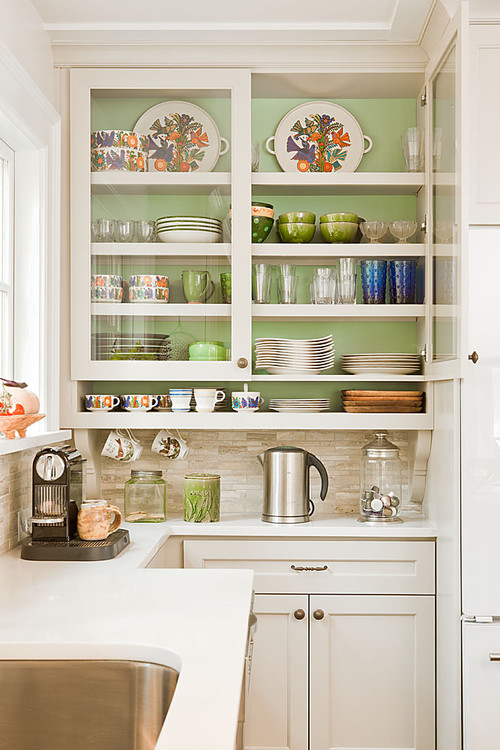
Glass-front cabinets are all the rage—you might even have a set in your kitchen right now. But rather than style (and restyle) the plate stacks and glasses inside, let paint step in (again) to do the tough work of updating and beautifying your workaday cabinets.
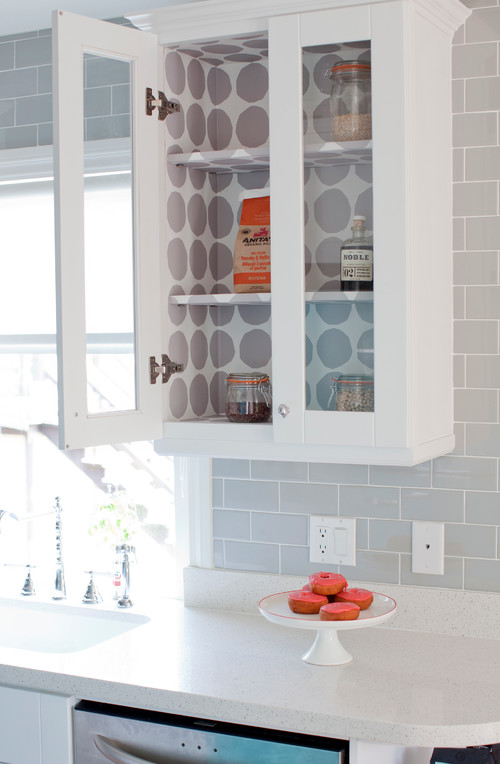
“A fun pop of color on the backs of a few glass-front cabinets adds interest to the room and lightens up the look,” Henry says.
Just as bright paint can enliven your cereal bowl display, so too can a couple of pieces of wallpaper. Even better: Make it temporary paper, which you can remove anytime you need a change.
And don’t stop with cabinet backs—temporary wallpaper is a nifty surprise along your drawers’ outside edges. (Just pull the drawers open to reveal a pretty pattern.)
You know that gorgeous glow you spy on Instagram when you’re scrolling kitchen renovations? It comes from under-cabinet lighting. This smart upgrade brightens shadows that are invariably created by overhead pendants and can be installed by a pro for just a couple hundred bucks.
Want to go cheaper? You can get lights that plug in to existing sockets or grab some adhesive lights to press on in dark corners. Or just place a couple of small lamps you already own along counters under your cabinets.
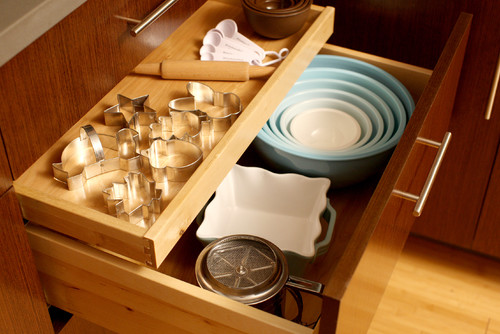
A simple rack or drawer rearrangement can take advantage of unused kitchen cabinet space. If you’re a wine person, you can quickly create an X design with plain wood for stacking bottles on their sides.
You may not notice it at first, but molding is the unsung decor hero in every room. Simple pieces of crown molding, whether stacked, stepped, or the traditional variety, can be added to the tops of your cabinets for an upgrade that looks custom and expensive.
Karen Gray-Plaisted of Design Solutions KGP approves of crown molding on top of cabinets as it extends the design right the ceiling.
“Or reconfigure just a couple of upper cabinets to reach your ceiling like the ones around the sink or refrigerator area,” she says.
You might also try bottom molding, which is just what it sounds like: decorative pieces you attach to the edges or the base of lower cabinets or the kitchen island.
Adding these “feet” transforms lowers or an island, making them look like pieces of furniture.
Thanks!
Please fill out the form below and we will be contacting you shortly with information about your home.







 Christine Almarines


 Ingredients