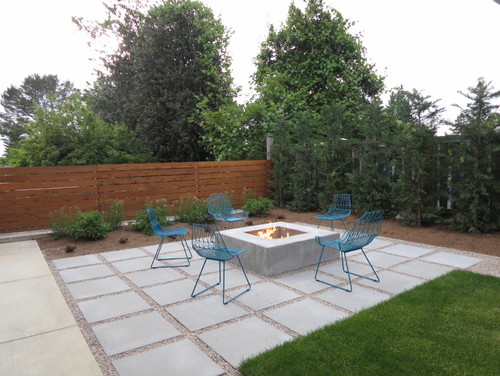
Halloween Hazards: Are Homeowners Liable for Injury to a Trick-or-Treater?

By Ana Durrani | Realtor.com | Oct 28, 2019

Part of the fun of Halloween is dressing up your home with the spookiest decor and doling out candy for eager trick-or-treaters. But what happens if someone walks through your yard on Halloween night and gets injured? It’s an unfortunate but realistic scenario that can have a number of consequences for homeowners. Worst-case—and scariest—scenario? Someone brings a lawsuit claiming that a trick-or treater got injured on your property. Would you be liable for this claim?

Under the law, if a porch light is on, trick-or-treaters are considered to be invited visitors, and it is a homeowner’s responsibility to have a property free of hazards. If anyone who enters your property on Halloween night gets injured, most homeowners insurance policies will cover minor injuries.

However, homeowners could be liable if trick-or-treaters are injured on their property if it can be proven that they were negligent in causing or contributing to that injury, says Jared B. Staver of Staver Accident Injury Lawyers, in Chicago.

For example, he says, a large crack in your walkway would be hard for someone to see in the dark. If a person tripped and broke a bone, he may claim you were negligent for not posting a warning sign and bringing attention to the crack.

“There is a reasonable expectation that you will receive visitors on Halloween. As a result, taking a few precautions will help guarantee the safety of trick-or-treaters and protect the homeowner,” says Christopher Layton of the Layton Law Firm, in Charlotte, NC.

To ensure a happy—and hazard-free—Halloween for all, here are some important questions homeowners should ask themselves before the trick-or-treaters come around.

Is the outdoors well-lit?

Make sure outdoor lights are bright and your yard is well-lit for little ghosts and goblins. Motion sensors are a good way to illuminate the house.

“Walkways should have lighting, and porches should be illuminated. If there are any danger zones, they should be well-marked and indicated with lighting as well,” says Staver.

Glow-in-the-dark or solar lighting is often not enough for late-night Halloween adventures, he cautions. Homeowners should instead invest in high-powered wattage.

Also, avoid using real candles in carved pumpkins or paper lanterns, since they are a fire hazard. Instead, opt for faux candles with LED bulbs.

Are there any tripping hazards?

It’s a good idea for homeowners to consider how children will enter and exit their property, says attorney Robert Fisher Jr., a partner at Edgar Snyder & Associates, in Pittsburgh.

“There’s a good chance that kids won’t always use your walkway, come to the door, grab the candy, go back down the walkway, and then enter the sidewalk in a direct path. It is more likely they will cut through the yard and use shortcuts. Keep your yard clear, and mark any potential hazards,” he advises.

This means fixing loose bricks and or cracks on pathways, or at least pointing them out with a sign, so kids won’t trip on them.

Scott Holeman, a spokesman for the Insurance Information Institute in New York, also recommends removing any leaves or branches from the path to your home.

More elaborate decorations like inflatables may require electricity, which means you will have to run an extension cord through your yard. It’s best to keep these tripping hazards as far away from walkways as possible and make it clear that trick-or-treaters should stay on the walkways. You can do this with a makeshift fence or luminary bags with LED lights.

To eliminate the need for trick-or-treaters to even walk through your yard, Layton suggests setting up a table at the end of your driveway and handing out candy from there.

“This saves the eager kids a long walk up to the front door, and helps the homeowner by reducing the potential for injuries on the property,” says Layton.

Are my decorations intended to scare people or make them jump?

We don’t blame you for wanting to go all-out when decorating for Halloween, but to minimize the potential for injury, it’s probably wise to go easy on the scary special effects. These can cause jump scares and could result in someone tripping and falling. Strobe lights and fog machines, two popular features used in elaborate Halloween decorations, also have the potential to cause problems like seizures and asthma attacks.

Are the steps to my home unobstructed and slip-resistant?

Remove plants and other objects from your steps. If the weather report says it could be a rainy night, apply friction tape to the steps to make them less slippery. And if you experience an early freeze, make sure to have ice-melt on hand to de-ice your steps.

Are pets secured out of the way?

Even the most well-behaved pets can be unpredictable and react to harmless trick-or-treaters. That’s why it’s best to keep your pets indoors.

“If you have pets, you should keep them in a separate room from the entry. With heavy activity, they could become frightened. To avoid potential bites or pet escapes, it is recommended that they be confined to another area in your home,” says Holeman.

It’s worth noting that if a dog bites a visitor, the homeowner is generally liable for the incident, according to Staver.

“Many homeowners insurance policies have dog bite clauses and cover these situations as long as the homeowner revealed that they owned a dog when obtaining the policy,” he says.

Should I skip the homemade treats?

If you are giving out homemade candies, cookies, or other treats, you may be liable for injuries due to illnesses such as allergic reactions to peanuts.

Layton says despite the loving care that goes into homemade treats, Halloween is not the right time for them.

“Kids will go home with so much candy, and if they are injured by any of it, you, the homeowner, want to be able to simply point to the manufacturer of the treat, rather than be singled out as the person who gave out the handmade treats,” says Layton.

Although your homeowners policy covers injuries on your property such as slip and fall, it likely won’t cover a food-related illness. Bottom line: Stick to store-bought candy.
By Cathie Ericson | Realtor.comSep 26, 2021

Does anyone who is not from the other side of the galaxy really need to ask, “What is the definition of a bedroom?” Actually, yes. Welcome to the nuances of real estate speak, where not everything is as it seems. You can’t simply place a bed in any size average space and call it a master bedroom.

There are, in fact, a number of details that make a room a “bedroom”—and both home buyers and sellers had best know them to avoid misunderstandings related to size and square footage.

“Since a home and/or master bedroom can go through many incarnations over its life, sellers should be familiar with what makes a bedroom a legal bedroom prior to listing their home, to ensure there are no issues holding up the sale when a buyer has been secured,” says Carl Ekroth of Douglas Elliman in New York City.

Bedrooms are one of the most important selling features of a home, notes Mark Abdel, a real estate professional with Re/Max Advantage Plus in Minneapolis–St. Paul.

So it’s no surprise that homeowners want to move a bed into a space and then slap that label on rooms of almost any size.

“Sellers can usually set and get a higher price the more bedrooms a home has,” Abdel says. But getting creative with your habitable space and trying to wedge a standard bed or twin into too few square feet just won’t fly. In fact, there are legal bedroom requirements and minimum bedroom sizes to take into consideration.

Legal bedroom requirements vary by state, but here are six ways you can tell if your room is a bedroom rather than just an average “room”:

  1. Minimum bedroom size: Yup—size and the number of square feet you have matter and not only because you want to fit in a bed, nightstand, and other furniture. This is the top issue, says Shaun Anders of Douglas Elliman. Although sizes can vary from state to state, 70 to 80 square feet in size is generally the acceptable minimum. “Sellers in urban markets such as New York City and Chicago would love rooms of 5 by 7 square feet to qualify as a bedroom, but no go,” says Anders.
  2. Minimum horizontal footage: The minimum square footage doesn’t tell the whole tale. A bedroom must also measure at least 7 feet in any horizontal direction. That is why you can’t call a 10-foot hallway a bedroom (you’d never fit a bed, mattress, dresser, or other furniture)!
  3. Two means of egress: There have to be two ways out of a bedroom. Traditionally, these would be a door and a window. Ekroth adds that, in most markets, a skylight would also qualify as that means of egress. You’ll have to leap from your bed to this upper exit, but that’s another discussion.
  4. Minimum ceiling height: There are more size dimensions to worry about here: At least half of the bedroom ceiling has to be at least 7 feet tall. So you can put a bed in a loft area with less than a 7-foot ceiling if the other section has a higher clearance.
  5. Minimum window size: The window opening must be a minimum size, usually 5.7 square feet.
  6. A heating and cooling element:  Your “master bedroom” needs these amenities, including a heater (a space heater won’t qualify) as well as a way to cool it down, whether that’s by opening a window or good old AC.

Does a room need a closet to be a bedroom?

Have you asked yourself, “Does a bedroom have to have a closet?” Well, contrary to popular belief, a bedroom does not need a closet (or a walk-in) to be considered official (forget the en suite bathroom). Your significant other might disagree, but legally, at least in most states, it does not.

Closets are expected in newer homes and definitely in master bedrooms, but older ones might require a more creative approach to stowing your clothes.

So what can you call a room or space that doesn’t hit these average 7-foot requirements? Based on your state, you could get away with calling it an “office,” “nursery,” or “bonus room.” Because bedroom or not, just about any indication of extra space will make most buyers’ eyes light up.

If your space is short a foot or two, you might consider an interior remodel project to add square feet and fit the bed you want (even a king-size bed or California king). But most homeowners will try to fit a standard full-size bed, twin bed, or queen-size bed, along with a dresser, in the space to accommodate the size average requirements. But don’t let dreams of more square feet in your average room put you off—a quick reno in your home or apartment might be the solution, depending on your budget.

If you’re still not sure if your room is technically a bedroom, ask your agent before putting your home on the market. Don’t have one yet? Contact CA Real Estate Group today.


Meet the team! CA REAL ESTATE GROUP TEAM MEMBERS:

Team Lead: Christine Almarines @carealestategroup
Realtor | DRE # 01412944
714-476-4637 | christine@carealestategroup.com

Maelyn Galapir @soldwithmaelyn
Realtor | DRE # 02031676
562-508-7819 | maelyn@carealestategroup.com

Michelle Kim @michellejeankim_homes
Realtor | DRE # 01885912
714-253-7531 | michelle@carealestategroup.com

By Jennifer Kelly Geddes | Realtor.comSep 6, 2021

Got files, papers, and pens strewed all over the dining table? In the dark days of the COVID-19 pandemic, many people used their dining space as a home office. But now that many are resuming their commute to work—and might be up for entertaining small groups of friends and family at home—the dining room is way overdue for a makeover.

While not everyone has a dedicated dining room, the following refreshes can also be applied to breakfast nooks or eating areas that share space with other rooms. The goal: a cozier, cleaned-up dining spot that’s both inviting and attractive. Here’s how to do it.

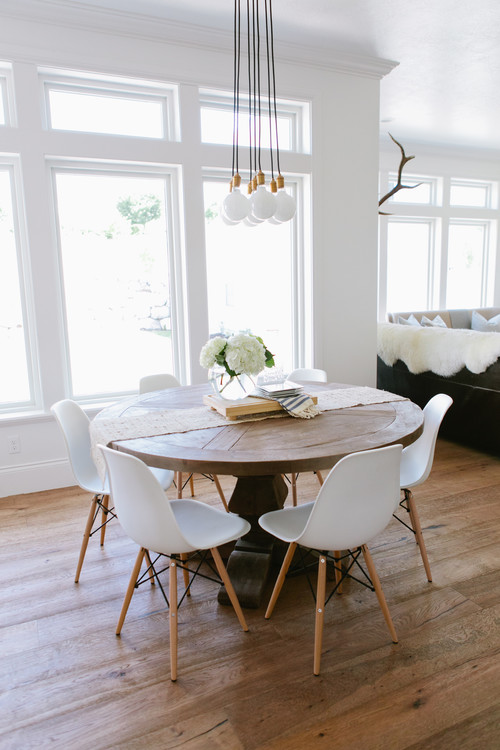
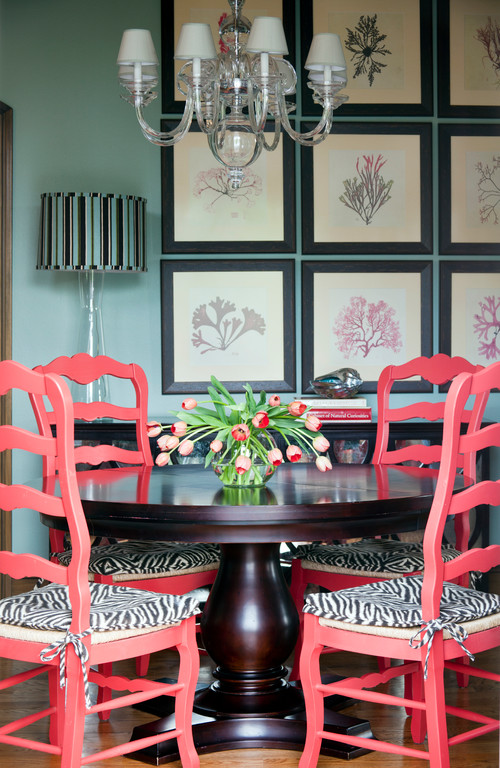
1. Try a round table

Photo by Tobi Fairley Interior Design 

The size of your dining space will usually dictate the shape of table you can accommodate, but experts agree that round tops square or rectangular every time. And since many of us will likely get back to entertaining by hosting smaller gatherings, you don’t need an enormous table in most cases. (One that’s 48 to 60 inches in diameter will suffice.)

“A round dining table gives a more intimate feel for groups of four to six people, and they allow for conversations to be close and inclusive,” says Ana Rovai, an interior design assistant at Perlmutter & Freiwald.

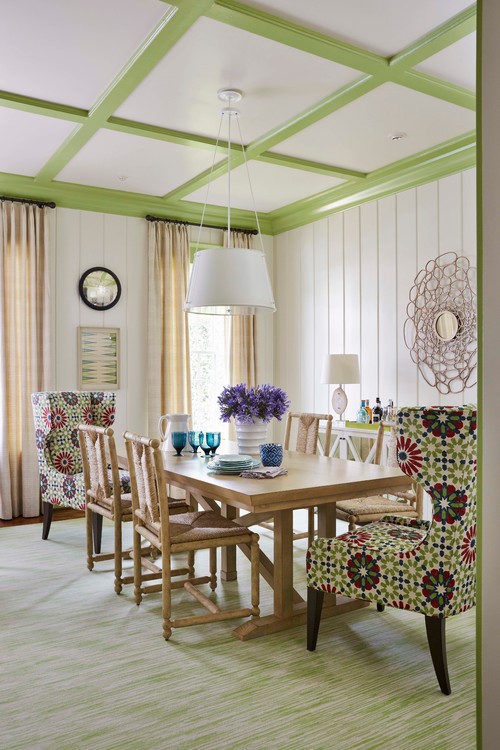
2. Jazz up the upholstery

Bright green upholstery offers a refreshing color pop.

(KT2 Design Group)

Months of teens sitting at the dining table doing homework has likely resulted in yogurt blobs, Dorito dust, and other sticky stains on your dining chairs. Fresh fabric is the fix here, though strategically placed throw pillows can also hide a multitude of sins for less money.

You might consider a two-tone approach with upholstery in the dining room. This means you don’t need to cover all six chairs in the same fabric. Instead, upholster just the backs or fronts with a fun pattern, and leave the rest more muted.

“Take advantage of a trend for your dining room rehab such as mix-and-match decor,” says Marty Basher, a design expert with Modular Closets.

Other popular items on the most wanted list this year include velvet fabrics and rattan everything (think seating, wall hangings, baskets, and more).

3. Consider hostess chairs

Photo by Andrew Howard Interior Design 

Wait, what’s a hostess chair? This unique seat usually comes in a pair (as in, host and hostess), with one placed at each end of the dining table. The idea, of course, is that the home’s host and hostess take these seats, which offer them easy access to the kitchen to fetch food and drink.

“Using hostess chairs adds style and feels fresh and modern when compared to a matching dining set,” says Amy Leferink, owner and principal designer at Interior Impressions.

Owning a pair of hostess chairs is another opportunity to infuse pattern or texture via fabric and to choose a new chair style at the table, such as wingback or club.

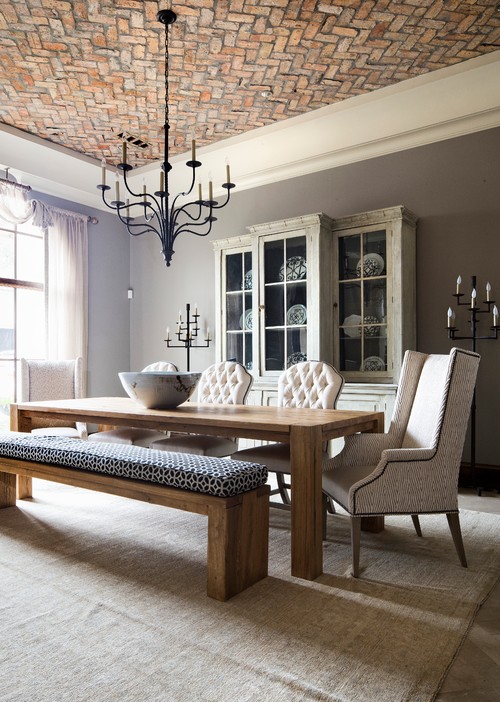
4. Remove two chairs, then add a bench

Photo by Houzz

Chair, chair, chair. A dining room with all the same seating is a visual snooze. But a bench in this space is a secret weapon, allowing you to squeeze in more people. It’s also a cozy spot for seating three or four kids at a party.

Using a bench in the dining room also means you can pull it away from the table for extra seating in another room, tuck it tightly under the table to save space, or upholster it with a fabric that complements the room’s palette.

5. Decorate the ceiling

Photo by Lisa Weiss Interiors

Wallpaper on the ceiling is always a surprising detail. (You can use a contrasting paint color the same way.) Invariably someone will look up as they enter the room and then coo with delight.

“Wallpaper or a painting project is always compelling, but it can also feel overwhelming, so focusing just on the ceiling is an easier transformation with equal impact,” says Rebecca Johnston of the eponymous design firm.

A wild pattern or bright shade can open up your dining room and delineate the area as a separate space. And if your dining room features molding or a tray ceiling, adding wallpaper or paint can highlight these often ignored details.

6. Use a runner

Photo by House of Jade Interiors 

Fine table linens dress up a table beautifully, but for casual parties, lay down a runner. This simple piece lightens your dining room’s look and signals a low-key, comfortable ambiance that most people prefer. No runner? A beach sarong or lightweight tea towel can be folded into a rectangle and used for the same effect. (If it has kicky fringed edges, even better!)

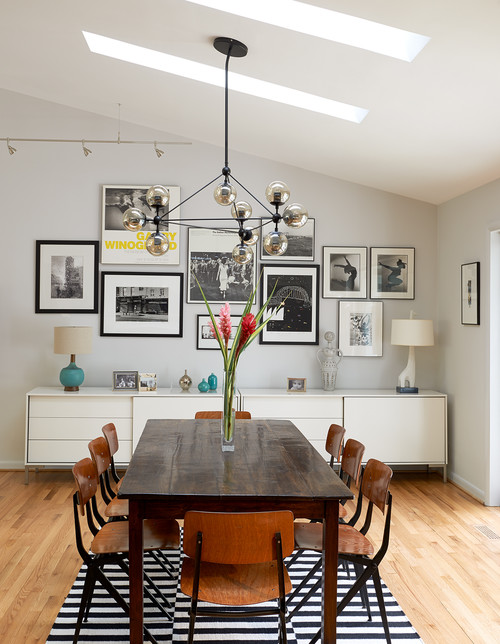
7. Rehang your artwork

Photo by Houzz

Those flea market posters you bought on vacation and brought home eons ago are due for an update. Spring for professional framing and matting to take these average pieces in your dining room to the next level.

Or rehang your existing wall gallery with a new design. (It’s easy to map it out on a piece of paper or arrange the idea on the floor first.) Another option: Ditch pictures and try hanging something more surprising.

“My personal favorites on a dining room wall are oversized macramé hangings or an assortment of wicker baskets in varying sizes,” says Basher.

Head to Etsy, he says, for gorgeous hand-woven products made from natural fibers and grasses.

We’ll take the guess work out of determining if an “AS-IS” house is a killer deal or not, and we’ll negotiate a price until it’s a DEAL that works for you!” — CA Real Estate Group

By Lisa Johnson Mandell | Realtor.com | Oct 3, 2021

Selling a house as is sounds like a pretty sweet deal for sellers. Sellers don’t have to scurry around fixing the place up.

But what does an as-is home sale mean for buyers? When looking through property listings and the term “as is” appears, some people see it as a warning.

Others, such as real estate investors, may see a house being sold as is as an opportunity. That might get prospective buyers wondering what exactly does “as is” mean?

Selling a house as is: What does “as is” mean in real estate?

Technically, when a real estate agent lists an as is home sale, it means the homeowner is selling the home in its current condition, and will make no repairs or improvements before the sale (or negotiate with the buyer for any credits to fund these fix-its). The term “as is” is rarely tacked on a property sales listing that’s perfect and move-in ready.

On the contrary, people often sell as-is homes that are in disrepair, because the homeowners or other sellers can’t afford to fix these flaws before selling (which would help them sell the home for a higher price).

Alternatively, a home may have been through foreclosure and is now owned by a bank, or the seller may have died and left the house to inheritors or an estate agent who have little idea what could be wrong with it but need to sell.

Whatever the reason, the current sellers aren’t willing to pretty up a home before selling it. They just want to sell the real estate and move on. All of this means that the buyer of this house inherits any problems a home may have, too.

When a real estate agent lists as home to sell “as is,” that doesn’t change the legal rights of the buyer. The listing agent must still have the seller disclose known problems, and the buyer can still negotiate an offer with the final sale, contingent upon a real estate inspection.

Pros and cons of as-is home sales

So how can “as is” be the aforementioned opportunity, if the buyer is taking on all those problems?

It all comes down to cash value. Those two short words in a listing usually indicate that the home may be considered to be a fixer-upper. The house will have a relatively low list price to start with, and the sellers might even entertain still lower offers.

A real estate agent may even list a house with serious problems as “cash offers only,” if the house’s problems could prevent it from qualifying for a mortgage.

If the prospective buyers happen to be contractors or handy with a hammer, are looking for a property to flip, or maybe just want an extreme bargain, the promise of an as-is sale could be music to their ears.

Cash buyers and corporate investors look for home sellers who want a fast sale, but they expect those sellers to offer a low list price in exchange.

Yet the downsides of an as-is property are obvious and should not be underestimated. Any number of things could be wrong with the house that are not immediately apparent to the eye. Buyers might think they’re getting a killer deal, but they could also be throwing their life savings into a black hole.

Should you buy a house being sold as is?

Now that you know the pros and cons of an as-is home sale, you might be wondering whether to move ahead with the sale—and how. Since these sales can be bargains, they are worth considering, although there’s one precaution buyers will definitely want to take prior to the sale: a home inspection.

A home inspector examines the house from basement to rafters and will point out any problems plaguing the place that may make the buyer want to reconsider the sale. The problems can be current or potentially in the buyer’s future, such as an old roof that may need replacing five years later.

A real estate inspection costs around $300 to $500, and typically occurs after the buyer has made a sales offer on real estate that’s been accepted and put down a deposit.

The buyer, not the seller, pays for the inspections—which makes sense, because that way the inspector is not working for the seller.

On houses that aren’t selling as is, buyers may use problems found during the inspection to demand that repairs be made (or that credits be given so they can make those repairs themselves).

While as-is home sellers have already made it clear they won’t lift a finger on that front, an inspection still serves an important purpose for buyers before the sale.

Provided the buyers place an inspection contingency in the contract, this means that if the inspector unearths problems, the buyers don’t want to address, they can walk away from the deal with deposit in hand.

“You should always elect to do a home inspection, especially on a bank-owned property where no one knew how the home was cared for and no one knows what happened right before the past owners left the property,” says Winston Westbrook, a broker and owner of Westbrook National Real Estate Co. specializing in short sales and distressed real estate.

“Yes, you lose out on the cost of the home inspection, but the cost of the home inspection is well worth it, considering the headache you would have had in the future trying to make the house livable.”

On the other hand, if the inspection reveals additional problems, you might consider offering a lower price based on estimated costs of home improvement.

Remember that, despite what the seller says in the real estate listing, a real estate deal is still open to negotiation. If the sellers have a property on the market and it doesn’t sell, they may be open to selling at a lower price.

The sellers may even make certain fixes requested by home buyers, if that’s the only way they can sell the house.

Unless it’s a hot real estate selling market and other potential buyers are competing with you, the listing agent knows that the property won’t sell until you get a deal that works for you.

? Water is not always our friend. Sure, we drink it, swim in it, and need it to survive, but when it comes to homes, it can destroy the foundation, says home inspector Thomas Dabb of Immaculate Home Inspections in South Orange, N.J.

? Water can enter a home from the exterior and interior, so buyers and homeowners need to keep their eyes open for signs of its presence—or worse—its damage.

? The good news is that there are many experts available to spot and diagnose a problem and suggest the best fix. Water expert Steve Barckley with Exceptional Stone Products in Livingston, N.J., believes that homeowners should start by doing everything possible on the outside of the homes to correct problems and divert water away from a foundation.

? Share these seven solutions with your family and friends to help them minimize a foundation’s damage in various scenarios.

Some Highlights

5 Fabulous Ideas To Give Your Foyer a Face-Lift, Straight From Instagram

By Larissa Runkle | Realtor.com | Sep 10, 2021

We love the feeling of walking into a foyer that’s perfectly styled. Unfortunately, entryways are one of those spaces that seem to be in a constant state of chaos—especially after months of gardening, football practices, beach and pool days, and more.

If you’re ready to sweep out the sand and soil and polish up your entryway, then you’re going to love this week’s Instagram-inspired decor trends. With gorgeous statement pieces and small must-have accents, this list has a style upgrade for your foyer that’s within every budget.

1. Funky railings

Looking to go big and mix up your decor? Then you just might like this funky railing inspiration from @theryanhaus_.

“With so many homes featuring a staircase as soon as you walk in the door, more and more homeowners are looking to make their railings a statement,” says designer and co-founder Betsy Moyer of Retreat Designs. “Ornate iron railings are falling to the wayside as combinations of rustic and modern flood into the zeitgeist.

“From this mix of weathered wood and horizontal cable, to the more art deco pattern–inspired wrought iron, I’m liking what I’m seeing with these new funky railings,” she adds.

Get the look: Design your very own funky railing with Custommade.

2. Leather organizing baskets

These trending leather baskets from @celebratedspaces are so cute there’s basically no reason not to snag a few (especially since they also make storage stylish—a win-win).

“We are all about extra storage looking like art,” says Moyer. “Elements in repetition always create a visual balance that the eye loves. Selecting a natural, textural material like sea grass or leather hides the colorful contents and keeps the palette peaceful, plus it provides great options for entryway clutter.”

Get the look: Corral your clutter with this two-piece leather bucket set.

3. Concrete accent table

Concrete has been all over the outdoor decor scene for a while—and now, thanks to design-savvy influencers like @bloomandbabe, it’s made a debut inside, specifically in the foyer.

“A concrete table adds a sense of strength and stability to the room,” says designer Andra DelMonico, of Trendey. “Concrete easily blends with a variety of interior design themes—from industrial, rustic, elegant, or even bohemian. Look for a concrete piece that creates a presence but won’t be too visually heavy in the room.”

Get the look: Shop this Byron waterfall console table.

4. Extra-large wall clock

Big clocks aren’t just for train stations, and @homesweet4everhome offers the proof.

“Adding an oversized clock is an easy solution for an empty wall,” says DelMonico. “The clock is both decorative and functional—perfect for entryways as a focal point over a console table. Skip the overused standard large wall clock and opt for something creative.”

Get the look: Try this oversized Bowdoin wall clock for a look that’s anything but boring.

5. Vanity-inspired bench

There’s something incredibly nostalgic about a vanity bench, and @scoutdesignstudio is here to show us just how well it works in the entryway.

“The vanity bench is a great style moment,” says Moyer. “It acts as another surface to fill the space beneath the console and naturally doubles as spare seating when you need a lingering goodbye at the door or spare seating for a holiday party.”

Get the look: Complete your foyer table with this Rainer upholstered bench from Wayfair.

Keeping Current Matters | September 10, 2021

When it comes to the current housing market, there are multiple misconceptions – from what the current supply of available homes looks like to how much houses are selling for.

It takes professionals who study expert opinions and data to truly understand the real estate market and separate fact from fiction.

Trust the pros at CA Real Estate Group.  If you want to understand why it’s still a good time to buy, let’s connect today.

CA REAL ESTATE GROUP TEAM MEMBERS:

?? Team Lead: Christine Almarines @carealestategroup
Realtor | DRE # 01412944
CA Real Estate Group | Keller Williams Realty
714-476-4637 | christine@carealestategroup.com

?? Maelyn Galapir @soldwithmaelyn
Realtor | DRE # 02031676
562-508-7819 | maelyn@carealestategroup.com

?? Michelle Kim @michellejeankim_homes
Realtor | DRE # 01885912
714-253-7531 | michelle@carealestategroup.com

Jennifer Kelly Geddes | Realtor.com | Mar 29, 2018

What are the best trees for privacy, shade, and your yard in general? Such questions are well worth asking, since not all flora are created equal. For instance, certain trees are yard maintenance nightmares. Other trees give and give—keeping you cool under the hot sun, shielding you from nosy neighbors, bearing fruit, and sprouting flowers—the list of benefits goes on and on!

Curious about which trees top landscapers’ lists? The first step is to identify your area’s planting zone, so you know what’s most likely to survive and thrive. These zones, as determined by the U.S. Department of Agriculture, are based on the average minimum winter temperature. With respect to your planting zone, here are some recommendations to help you pinpoint the best trees for shade, privacy, and your yard in general.

Best trees for shade


Photo by orlando comas

The mighty oak, shown in the photo above, is your go-to for shade in nearly every planting zone in the U.S.

“Oaks provide extensive, deep shade due to the density of their leaves,” reports Cassy Aoyagi, president of FormLA Landscaping in Los Angeles.

Both oaks and sycamores can cool the air beneath their canopies by as much as 20 degrees Fahrenheit, she notes.

For homeowners in zone 6 and warmer climates, look to flowering dogwood, shown in the photo below, and white spruce, says Burt DeMarche, president of the LaurelRock Co., a landscape architectural firm in Wilton, CT.


Photo by Plan-it Earth Design

“Dogwoods are great native understory trees that provide a splash of color, with pink or white spring flowers and burgundy red fall foliage,” he says.

Are you more into evergreens?

“White spruce is one of the most tolerant evergreens, with a heavy cone in the top branches throughout the fall and winter, which gives it a very Alpine feel,” he adds.

Best trees for privacy


Photo by Coates Design Architects Seattle 

The conical Leyland cypress trees, shown on the right in the photo above, can create lush cover between homes for privacy.

“These fast-growing trees can grow 3 feet in a year and thrive in zones 6 to 10, which is a large part of the U.S.,” explains Chris Lambton, a landscaping expert on “Lawn & Order” and host of “Yard Crashers.”

Other options include American holly evergreen, with beautiful red berries in winter, green giant arborvitae, and Japanese holly, which grows compactly and is an excellent tree for screening.

DeMarche is also a fan of the green giant, shown in the photo below.

“It makes a terrific hedge at 6 to 25 feet tall, plus its deep, green foliage has a uniform, luxurious sheen, and it’s deer-resistant,” he points out.


Photo by Cording Landscape Design

Best trees for front yards


Photo by FormLA Landscaping

Want a real showstopper tree for your front yard? First, consider the space and available light, as well as the architecture of the home and the impact you’re trying to achieve, says Aoyagi.

If you have a large space, try a sycamore, shown above, which meshes well with many architectural styles and across many climates.

“In small spaces, I recommend the Western redbud, palo verde or desert willow [shown in the photo below], which have extended bloom times and pretty leaves—particularly redbuds, which range from green to bright red and burgundy in the fall,” she adds.


Photo by Treeland Nursery 

Or try a Japanese flowering crab apple, with red buds that turn pink and then white before dropping, says DeMarche. “This tree attracts birds, butterflies, and hummingbirds.”

The tricolor European beech is also a stunning tree in the yard, he adds. “It sits beautifully as a stand-alone feature in an open space with green and white variegated foliage.”

Best trees near the house


Photo by Katia Goffin Gardens 

Upright European hornbeams (shown on the left in the photo above) work well as an anchor at the corner of a house in zones 6 and warmer, says DeMarche.

“Its narrow form when young eventually morphs into a teardrop shape that can readily be sheared to maintain an overall size of 10 to 20 feet,” he notes. “It also makes a great statement within foundation planting and is care-free with regard to insects and diseases.”


Photo by Wagner Hodgson

Other colorful trees in this category include the easy-care ivory silk Japanese lilac (shown in the photo above), which sports bright flowers in June, and the serviceberry, with small, edible fruit and blue-green leaves in the fall, says Craig Jenkins-Sutton, president of Topiarius.

Best trees and shrubs for landscaping


Photo by Matthew Cunningham Landscape Design LLC 

“The Japanese stewartia (shown in the photo above) is the perfect foundation tree, topping out at 8 to 18 feet in maintained landscapes,” says DeMarche. “Its large, camellia-like white flower in June and July provides spectacular display and is followed by a rich mix of scarlet, pink, purple, orange, yellow, and green foliage in the fall.”

And don’t forget sizable shrubs and bushes with your tree mix. Lambton’s favorite landscaping flowers are hydrangea for its gorgeous blooms all summer and into the fall, and rhododendron for its variety of colors and early spring blooms.


Crave Shade? The No-Brainer Upgrade Your Outdoor Space Needs This Summer

By Jennifer Kelly Geddes | Realtor.com | Aug 6, 2021

If your home’s outdoor space could stand for a bit more shade or protection from the elements, an awning may be just the ticket.

At its most basic, an awning is a piece of material attached to your house that unfurls to cover a patio, deck, door, or window. It can be permanent or retractable (with either a hand or motorized crank).

An awning shields areas from the sun, allowing outdoor areas to become more shady, cooler, and usable during the hottest hours of the day. You’re also protected from rain, which means you won’t have to cancel so many cookouts with neighbors. All in all, awnings can create more livable space outside your house that you can use in all kinds of climate and weather.

But awnings actually do a lot more than serve as a buffer from the elements. Here’s more about awnings, from their secret benefits (both indoors and out) to the various styles and materials you can consider, plus some tricked-out awning upgrades that’ll make your summer all the sweeter.

The benefits of an awning

Although the main benefit of an awning is its power to transform outdoors areas into shady spots you can use regardless of sun and rain, one oft unsung benefit is the money you’ll pocket in energy savings—particularly for awnings placed over windows.

According to the U.S. Department of Energy, awnings over windows can cut the amount of summertime sun your home gets by 65% on south-facing windows, and 77% on western ones.

So if you’d like to run your air conditioning a lot less, an awning that covers one or more of your hot sunny windows is the ticket.

Plus, awnings protect not only outdoor areas, but indoor spaces, too. With less sun streaming in, it can help safeguard your interior furnishings (including wallpaper, flooring, carpets, upholstery, drapes, and artwork) from ultraviolet rays, which can cause them to degrade and fade over time.

And don’t forget the obvious curb appeal that awnings can provide. Awnings with thick stripes, coordinated piping or edging, or scalloped edges or small cutouts can brighten an otherwise quiet exterior or backyard.

Types of awnings

In addition to the classic retractable awning attached to your house, free-standing awnings can be erected and then moved as needed from your deck to the lawn.

If you plan on opening and closing an awning often, motorized models are ideal due to their ease of use if you can swing the added cost.

“Try to go for an automated retractable awning, because the last thing you want is to deal with gears and and pulls when you’re trying to relax on the patio,” says Drew Henry of Design Dudes.

Awning costs and upgrades

A basic awning for one set of front windows or to cover an average-size back deck will  cost $150 or so. Prices go up from here, of course, depending on how many extras you want. Awnings that open and close at the push of a button will cost more than one that simply retracts with a cord and your own muscle.

On the higher end, you can spend as much as $7,000 for the most tricked-out versions, which may include built-in heaters, speakers to play music, or a misting system that lightly sprays cool water.

Best fabrics for awnings

From classic stripes to solids and simple patterns, an awning’s design is limited only by your imagination and budget. Darla DeMorrow, author of “Organizing Your Home With SORT and SUCCEED,” urges homeowners to select Sunbrella or similar fabric for outdoor awnings.

“It’s truly the gold standard for every outdoor accessory and comes in loads of colors that’ll coordinate with your home’s style,” she says.

This wonder material costs more, but it’s worth it as the fabric is highly durable; is resistant to water, mold, and mildew; and won’t fade quickly under the hot sun. Sunbrella allows some light through while also blocking dangerous UV rays and excess heat.

As for awning colors, stick to shades that match your house.

“If your home is white with green shutters, the safe bet is to install a white awning with green stripes,” says Henry.

Awning maintenance

After installing an awning in the front or back of your house, don’t let rotting leaves, bird droppings, pine sap, and other debris linger on the fabric or become rolled up inside when you retract it. Aim to give your awning a good wash twice a year by spraying it with a hose and using a long-handled brush and a gentle soap to remove stains.

Your awning’s arms and braces can also be cleaned, or you can call in a pro to do the job. (The pro might also check the gears, handle, and other motorized parts to ensure they’re in good working order.)


Thanks!

Please fill out the form below and we will be contacting you shortly
with information about your home.

Personal Info
Home Address
Message