There are ways to embiggen your home without spending a fortune.
When you first bought your first house, it probably seemed enormous, especially if you were moving from a tiny apartment. But inevitably, the longer you own it (and start filling it with stuff, pets, and children), the smaller it seems.
What’s to be done? Buy a larger home? Sure, but that’s going to be expensive, especially right now. Get a storage unit? Now your stuff is 20 minutes away, and you have a new monthly bill to pay. Add an addition to your existing house? Also expensive—but it doesn’t have to be. While adding a whole new room or wing to your house might be the ideal solution to your space needs, if you don’t have the cash for such a project, there are lower-cost options you could consider.
Finishing an existing unfinished space
The first option to consider is finishing the spaces that already exist. Unfinished areas like basements don’t count as livable space in your house, so finishing them adds value and space to your home.
If you have a garage, that’s going to be the cheapest space to finish. Garages are often already attached to the main level of the house, have a door connection to the rest of the space, and are probably wired up with electricity at the least. The average cost of converting a garage is around $15,000, though it can go a lot higher if you need to add plumbing for a bathroom or if your garage is very large (or if you’re trying to convert one portion of a 3-car garage and keeping the rest for a car). The main downside is the loss of covered parking, but this is a cheap way to gain square footage.
Unfinished attics and basements are also obvious targets for finishing, with the cost to finish a basement averaging about $23,000 and the cost of finishing an attic averaging $25,000.
Enclose an outdoor space
Another way to add square footage to your home cheaply is to take advantage of outdoor spaces that are already part of the home’s footprint, like patios and porches. This can be pretty involved, requiring new foundations and everything from plumbing to wiring in addition to adding walls, windows, and doors connecting the space to the existing home. Depending on the size of your patio, completely enclosing it can run you anywhere from $17,500 on the low end to several hundred grand on the higher end—which isn’t much cheaper than just adding a room. Enclosing a porch and making it into a four-season room can be cheaper, ranging from $20,000 to $80,000 on average.
A cheaper option for a porch or patio conversion is to create a sunroom or three-season room. Because these spaces lack insulation and heating, they’re generally cheaper to build (screening in a patio, for example, can be as cheap as $500, and a three-season porch can often be obtained for less than $10,000). While these won’t count as official bedrooms or anything and aren’t usable in colder weather, they still add value and usable space to your home.
If you’re handy, a cheaper option for a sunroom or three-season room conversion could be a DIY kit. These can get the job done for as cheap as $1,500 because they don’t include labor costs, and typically require just a few days to construct.
Create bump outs or dormers
An affordable option to add just a little space to your home is a bump-out or an attic dormer. A bump-out is a small addition to a room, sometimes as small as two feet in depth. They’re usually supported by the existing home’s foundation, so don’t require one of their own. Depending on the length of the bump-out, you can add a few dozen square feet to the living area of your house, and the costs range from $5,000 to about $32,000, depending on the size and complexity of the project.
Adding a dormer or two to your attic doesn’t actually add much square footage, but it can make the existing attic space into usable space by raising the ceiling height and adding windows. Attic dormers typically cost less than $20,000 to add, and can transform a tight attic into a sunny room.
Create a loft
If the interior of your house has at least one space with soaring ceilings, you can add some usable space by building a loft area. This can be a DIY project if you really want to keep costs down, and can give you an office space or additional storage space without sacrificing any existing areas. Depending on how ambitious you are (is this just a platform for a bed, or are you envisioning a fully-equipped office?) a lofted area within a room can run you anywhere from a few grand to tens of thousands of dollars.
Add a prefab shed/ADU
Finally, if you have backyard space, you could consider adding a tiny house (also called an Accessory Dwelling Unit, or ADU) or prefabricated shed space to your property. Tiny homes can be as cheap as $4,000 if you DIY the build, and you can wire them for power and add plumbing, climate control, and nice finishes to create freestanding living space. Be sure to check with your HOA or local government concerning permits and other requirements before you click “ORDER” on an entire small house.
Here is a list of currently open Orange County Farmers Markets. They serve many different communities of the OC. Most are certified and sell the produce of our local farmers and vendors. They are a great way to support small business here in Southern California.
Due to possible seasonal, holiday or weather related changes to times & locations, we encourage you to click on the link of the market event holder to get the most updated information. ‘Rain or Shine’ markets may have low vendor attendance on wet days.
Please note – this is an informational page only. If you have any specific questions about any of the markets listed, please contact the management company of the farmer’s market you are interested in.
Sunday Farmers Markets
Garden Grove
Historic Main Street, Main St. & Garden Grove Blvd.
Sundays
10 AM – 2 PM
More Information
Operated by Local Harvest Garden Grove Certified Farmers’ Market. Offering an abundance of farm fresh Certified California Grown Fruits and Vegetables, along with a variety of gourmet specialty foods. Arts, crafts and jewelry from local area vendors can also be found.
Irvine
The Great Park in Irvine, Marine Way off Sand Canyon
Sundays
10 AM – 2 PM (weather permitting)
More Information
Every week, the Great Park Certified Farmers Market features fresh, locally grown fruits and vegetables, handcrafted artisan products, live music and entertainment, and a selection of gourmet food trucks. Take home fresh produce grown on the Great Park Farm and other local farms and enjoy live entertainment, including live music, car shows, and more.
Ladera Ranch
Founders Park, 28275 Avendale Clubhouse in Parking Lot
Sundays
9 AM – 1 PM
More Information
Farmers, cottage producers, food trucks and craft vendors selling great food and products you can’t find at stores. The produce is grown locally using sustainable methods to reduce climate impact – much is organic. The small batch specialty producers make their products nearby using only the highest quality ingredients.
Laguna Niguel
27271 La Paz Rd, Laguna Niguel (Plaza de Paz Shopping Center)
Sundays
8 AM – NOON (rain or shine*)
More Information
Affiliated with Orange County Farm Bureau Sponsored Certified Farmers’ Markets. California certified farmers’ markets are the real thing – places where genuine farmers sell fruits, nuts and vegetables directly to the public. Every farmer who sells at a certified market is inspected by the county agricultural commissioner to make sure he/she actually grows the commodity being sold.
* According to the Orange County Farm Bureau, this is a rain or shine event. Even though this is a rain or shine event, please be advised many vendors may not attend markets on rainy days.
Newport Beach
Newport Beach Pier
Sundays
9 AM – 1 PM
More Information
Just steps away from the famous Dory fish market and beachfront shops and restaurants, this market is a staple for locals and a reason to make Newport Beach a Sunday destination. Shoppers will find a selection of exotic fruits, seasonal vegetables, eggs, honey, nuts as well as specialty foods like small-batch breads, Mediterranean dips, vegan salsas, cold-press juices, teas, handmade jewelry and art.
San Clemente
200 block Avenida Del Mar Dr.
Sundays
9 AM – 1 PM (rain or shine)
More Information
Affiliated with California Federation of Certified Farmers’ Markets. The certified farmers market concept is an effort to re-establish the traditional link between farmers and consumers in California. Put simply, certified farmers’ markets (CFM’s) are “the real thing,” places where genuine farmers sell their crops directly to the public. It is where the agrarian community relates to the urban community
Monday Farmers Markets
Currently there are no Monday markets in Orange County
Tuesday Farmers Markets
Huntington Beach
Surf City Nights is a Weekly Street Fair and Certified Farmers Market
Tuesdays
5PM – 9PM
More Information
Orange County’s largest weekly street fair and certified farmers’ market.
Every Tuesday from 5 pm to 9 pm, 90 vendors presents unique handcrafted wares: furniture, jewelry, art, clothing, live music, street performers, community groups and kids’ activities.
Orange
Irvine Regional Park
1 Irvine Park Road, Orange, CA
Tuesdays
9 AM – 1 PM (rain or shine*)
More Information
Affiliated with Orange County Farm Bureau Sponsored Certified Farmers’ Markets. California certified farmers’ markets are the real thing – places where genuine farmers sell fruits, nuts and vegetables directly to the public. Every farmer who sells at a certified market is inspected by the county agricultural commissioner to make sure he/she actually grows the commodity being sold.
* According to the Orange County Farm Bureau, this is a rain or shine event. Even though this is a rain or shine event, please be advised many vendors may not attend markets on rainy days.
Placentia
Placentia Town Center
130 E Yorba Linda Blvd.
Tuesdays
4 PM – 8 PM
More Information
This Certified Farmers Market provides approximately 30 unique and exciting vendors to the Placentia Town Center. A free shuttle bus to and from the Placentia Certified Farmers Market is now available with five different locations for picking up and dropping off.
Santa Ana
Located in the corner parking lot on Bush and 3rd Street in Downtown Santa Ana.
Tuesdays – closed for the season, please check back
More Information
The DTSA (Downtown Santa Ana) Farmers’ Market is a community-oriented, chef-driven Farmers’ Market that strives to bring the highest quality produce at the best price possible.
Seal Beach
Seal Beach Village
13904 Seal Beach Blvd., Westminster Blvd & Seal Beach Blvd
Tuesdays
9 AM – 1 PM
Opened in 2010, this small Tuesday market is convenient for nearby Leisure World residents. Around 15 vendors that and include many familiar to other Orange County farmers markets.
Wednesday Farmers Markets
Fullerton
Fullerton Community Center, 340 West Commonwealth Ave.
Wednesdays
8:30 AM – 12:30 PM
More Information
Believed to be the oldest farmers’ market in Orange County, this Wednesday market is renowned for the freshness of its produce and its wide variety of fruits, vegetables, plants and flowers – many of which cannot be found at local supermarkets. It is operated by the nonprofit Fullerton Certified Farmers Market Board
Irvine
Irvine Towers Certified Farmers’ Market
18400 Von Karman, Irvine, CA
At the Towers Main Courtyard
Wednesdays
10 AM – 2 PM
More Information
Farmers’ Market Featuring a wide variety of Food Vendors. Great place to get a lunch. Year Round, open To The Public.
Irvine
Irvine Kaiser Permanente CFM
6640 Alton Parkway, Irvine, CA
Wednesdays
9 AM – 1 PM
More Information
Located in front of the Medical Office Building. Affiliated with California Federation of Certified Farmers’ Markets. The certified farmers market concept is an effort to re-establish the traditional link between farmers and consumers in California.
Tustin
Corner of El Camino Real and 3rd Street
Wednesdays
9 AM – 1 PM (rain or shine*)
More Information
Affiliated with Orange County Farm Bureau Sponsored Certified Farmers’ Markets. California certified farmers’ markets are the real thing – places where genuine farmers sell fruits, nuts and vegetables directly to the public. Every farmer who sells at a certified market is inspected by the county agricultural commissioner to make sure he/she actually grows the commodity being sold.
* According to the Orange County Farm Bureau, this is a rain or shine event. Even though this is a rain or shine event, please be advised many vendors may not attend markets on rainy days.
Thursday Farmers Markets
Anaheim
Downtown Anaheim Certified Farmers’ Market & Craft Fair
435 W. Center Street Promenade, Anaheim, CA 92805
Thursdays
11 AM – 3 PM
More Information
Local California certified Farmers, International Foods, craft fair and Homegrown Music series.
Brea
Brea Place, 135 S. State College Blvd, Brea
In the parking lot off of S. State College Blvd.
Thursdays
3 PM – 7 PM
More Information
Affiliated with Orange County Farm Bureau Sponsored Certified Farmers’ Markets. California certified farmers’ markets are the real thing – places where genuine farmers sell fruits, nuts and vegetables directly to the public. Every farmer who sells at a certified market is inspected by the county agricultural commissioner to make sure he/she actually grows the commodity being sold.
Costa Mesa
Orange County Fairgrounds
88 Fair Drive, Costa Mesa
Thursdays
9 AM – 1 PM (rain or shine*)
More Information
Affiliated with Orange County Farm Bureau Sponsored Certified Farmers’ Markets. California certified farmers’ markets are the real thing – places where genuine farmers sell fruits, nuts and vegetables directly to the public. Every farmer who sells at a certified market is inspected by the county agricultural commissioner to make sure he/she actually grows the commodity being sold.
* According to the Orange County Farm Bureau, this is a rain or shine event. Even though this is a rain or shine event, please be advised many vendors may not attend markets on rainy days.
Friday Farmers Markets
Anaheim
Anaheim Kaiser Permanente CFM
3440 E. La Palma Ave. Anaheim, CA
Fridays
9 AM – 2 PM
More Information
Located across from the parking structure. Affiliated with California Federation of Certified Farmers’ Markets. The certified farmers market concept is an effort to re-establish the traditional link between farmers and consumers in California.
Fountain Valley
Mile Square Park Certified Farmers Market
16801 Euclid St., Fountain Valley, CA 92708
Fridays
9 AM – 1 PM (rain or shine*)
More Information
The Mile Square Park Certified Farmers Market is located at Freedom Hall in Mile Square Park. Genuine farmers sell fruits, nuts, and vegetables directly to the public. Every farmer who sells at a certified market is inspected by the county agricultural commissioner to make sure that he/she actually grows the commodity being sold.
* According to the Orange County Farm Bureau, this is a rain or shine event. Even though this is a rain or shine event, please be advised many vendors may not attend markets on rainy days.
Laguna Hills
Laguna Hills Mall Parking Lot
the 5 Freeway and El Toro Road
Fridays
9 AM – 1 PM (rain or shine*)
More Information
Affiliated with Orange County Farm Bureau Sponsored Certified Farmers’ Markets. California certified farmers’ markets are the real thing – places where genuine farmers sell fruits, nuts and vegetables directly to the public. Every farmer who sells at a certified market is inspected by the county agricultural commissioner to make sure he/she actually grows the commodity being sold.
* According to the Orange County Farm Bureau, this is a rain or shine event. Even though this is a rain or shine event, please be advised many vendors may not attend markets on rainy days.
La Palma
Kaiser Permanente Farmers’ Market
Kaiser Permanente La Palma Medical Offices
5 Centerpointe Drive, La Palma
(949) 364-1270
Every other Friday
10 AM – 2 PM
More Information
You can find fresh, nutrient-dense produce at a nearby Kaiser Permanente farmers market. We have locations at many of our facilities, so pack a tote bag and pick up your peaches, peppers, and prescriptions in the same trip. Located in the parking area on the south side of the building.
San Juan Capistrano
Farmakis Farms
29932 Camino Capistrano
(949) 364-1270
Fridays
9 AM – 1 PM
More Information
Family-owned Christmas tree farm and certified farmers’ market located in San Juan Capistrano. Come experience life on the farm every Friday from 9:00am – 1:00pm with our weekly certified farmers’ market. Features produce from many local farmers, breads, dips, sweets, jams, crafts, and many more locally made artisan products.
Saturday Farmers Markets
Buena Park
Corner of La Palma and Stanton Sears Parking Lot
Saturdays
9 AM – 2 PM
More Information
You can find organic fruits and vegetables, fresh eggs, raw honey, dried fruits & nuts, specialty foods, kettle corn, and a variety of fresh foods made to order!
Corona Del Mar
3201 Pacific Coast Hwy
(Marguerite & Pacific Coast Hwy)
949- 361-0735
Saturdays
9 AM – 1 PM
More Information
Limited parking on-street and in a small lot. Affiliated with California Federation of Certified Farmers’ Markets. Open since 1996, look for prepared foods, honey, fresh fish, and flowers—and lots of fruits and vegetables from premier growers often not seen at other markets.
Costa Mesa
SoCo Farmers’ Market
SoCo Collection
3315 Hyland Ave
Saturdays
9 AM – 2 PM
More Information
Located in the SOCO Collection, our SOCO Farmers’ Market in Costa Mesa is the perfect place to spend a Saturday afternoon. Featuring local farm fresh fruits and vegetables, raw honey, fresh almonds, fresh eggs, meat, and poultry.
Cypress
4505 Katella Ave, Cypress, Ca – in the parking of Cottonwood Church.
Saturdays
9 AM – 2 PM
More Information
The market features fresh fruits and vegetables, a variety of prepared foods including fantastic tamales and BBQ, as well as some artisanal vendors selling items such as fresh breads, hummus, honey and handmade soaps.
Dana Point
La Plaza Park at the intersection of Pacific Coast Highway & Golden Lantern
949-573-5033
Saturdays
9 AM – 1 PM
More Information
Selling produce, flowers, breads, fish, arts and crafts, pita, honey, nuts, hot sauces, humus, mixes, pickles, coffee, indian food, mushrooms, etc. In addition to local, organic produce and unique products from Dana Point businesses, arts & crafts vendors join in the fun every 2nd Saturday of the month.
Irvine
Mariners Church parking lot, On the corner of Bonita Canyon & Turtle Ridge
Saturdays
8 AM – Noon (rain or shine*)
More Information
Affiliated with Orange County Farm Bureau Sponsored Certified Farmers’ Markets. California certified farmers’ markets are the real thing – places where genuine farmers sell fruits, nuts and vegetables directly to the public. Every farmer who sells at a certified market is inspected by the county agricultural commissioner to make sure he/she actually grows the commodity being sold.
* According to the Orange County Farm Bureau, this is a rain or shine event. Even though this is a rain or shine event, please be advised many vendors may not attend markets on rainy days.
Laguna Beach
521 Forest Ave, Laguna Beach (across the street from the Lumberyard Shopping Center)
Saturdays
8 AM – NOON (rain or shine*)
More Information
Affiliated with Orange County Farm Bureau Sponsored Certified Farmers’ Markets. California certified farmers’ markets are the real thing – places where genuine farmers sell fruits, nuts and vegetables directly to the public. Every farmer who sells at a certified market is inspected by the county agricultural commissioner to make sure he/she actually grows the commodity being sold.
* According to the Orange County Farm Bureau, this is a rain or shine event. Even though this is a rain or shine event, please be advised many vendors may not attend markets on rainy days.
Orange
Orange Home Grown Farmers & Artisans Market
Located at 303 W. Palm Avenue
on the corner of Cypress & Palm in Old Towne Orange
Saturdays
9 AM – 1 PM (rain or shine)
More Information
The Orange Home Grown Farmers & Artisans Market is a Saturday certified farmers market operated by the non-profit Orange Home Grown, Inc. The market features a large selection of fruits, vegetables, nuts, mushrooms, honey, free range eggs, grass-fed beef, poultry and milk, and seafood,, fresh bread & baked goods, preserves and more. Enjoy complimentary coffee and music while you shop.
Source:
https://www.orangecounty.net/html/farmersmarkets.html
https://www.sandytoesandpopsicles.com/orange-county-farmers-markets/
As noted in our article about weather proverbs, what the skies and winds are doing outside dictates a lot about our lives and daily actions. When it’s hot outside, and that heat seeps into your home, it’s hard to muster up the motivation to do just about anything. You’re damp, sticky, sweaty — it’s just plain uncomfortable.
So are you supposed to languish in the summer months and blankly stare at the boob tube while sweat drips down your forehead? Of course not! If you have air conditioning (70% of U.S. homes do), you can always blast it and create a nice wintry environment for yourself. But that uses a ton of energy and jacks up your bills. Plus, the artificial chill just feels wrong when it’s so warm outside. Isn’t there a way to find a happy medium and be comfortable while still feeling like it’s summer out there? Darn right there is!
Below you’ll find tips to keep your house cooler when the thermometer creeps up and up, ways to make your A/C use more efficient, as well as what you can do to keep your own person more comfortable.

Windows/Blinds
Open windows at night. In places and during times of year where it substantially cools at night (overnight temps in the mid-70s or lower), pop the windows open once the sun goes down. You’ll be amazed at how quickly the warm air is replaced with cool, refreshing air.
Better yet, utilize fans (or a whole house fan if you have one) to create tunnels of cool air coming into your home. To get the most out of your efforts with this method, crack a window on the main floor of the house, while widely opening a window on the second floor on the opposite side of the home, with a fan in that one sucking air out. Since heat rises, you’ll more quickly get the hot air out and cool air in.
Keep blinds closed during the day. Up to 30% of unwanted heat in your home is coming through your windows via the greenhouse effect — sunlight and heat enter, but cannot escape. The remedy is to keep your blinds closed during the day; if this makes your home feel too much like a cave, focus especially on west- and south-facing windows. Doing this can actually lower the mid-day temperature of your home by almost 20 degrees.
To make this action even more efficient, get light-colored blinds that will reflect rather than absorb the sun’s heat, and open them again at night when it’s cool. You can even place cardboard in the windows to further block heat from entering.
Appliances
As discussed above, windows are one of the biggest sources of unwanted heat in the home. The other biggest violator: appliances. The obvious is the oven, but all appliances throw off a lot of heat when running. Below are tips that will mitigate their heat output. I cover some A/C tips in this section as well to maximize its use and efficiency.
Do chores at night. Laundry machines throw off a lot of heat. The washer is running hot water, and driers are obviously using heated air which inevitably escapes and radiates out from the machine. Now, you can’t get away with not doing laundry (hopefully), but you can ensure it’s not heating your home during the hottest parts of the day. Do your laundry loads at night to keep things cooler. Also, regularly clean the dryer vent for a quicker cycle.
Your dishwasher also puts out a lot of heat. Like with laundry, run it at night to minimize the heating effect. If you have a quiet model, start it before you go to bed and you’ll wake up with clean dishes!
Skip the oven/stove; grill more. Any usage of the oven or even the stove-top is going to heat your home. So what’s one to do? Dust off the grill and get comfortable with it! You can grill many of the things you’d be making in an oven or on the stovetop — meat, pizza, veggies, fish, and even desserts like cobbler!
If you do use the stove, make sure to turn the fan on, especially if it vents to the exterior. If it just recirculates the air, it won’t cool things much, but it will at least improve airflow.
Keep the furnace fan on. Most thermostats allow you to manually turn the fan on that blows hot air through your home in the winter. In the summer, that fan can be run on its own to circulate and more evenly distribute the cooler air from the basement or main level. It also acts as another way to keep the air flowing and moving, which makes you feel cooler (more on that below).
Maximize your air conditioner. If you have A/C, the smoother and more efficient it runs, the better it will cool your house when called upon. Installing a programmable thermostat can help this process, rather than you fiddling with the temperature every morning and evening. Summer temperature recommendations are as follows:
- 75 degrees, +/- 1-2 degrees, during hours you’re home (the warmer the setting, the more energy efficient; energy.gov recommends 78 degrees, which seems a tad warm to me personally)
- 80 degrees, +/- 1-2, during hours you’re away
- Sleeping: it’s well-researched that people sleep better when it’s cooler. If there’s a time to crank the AC a little bit, the overnight hours might surprisingly offer the most bang for the buck. Experiment with a few different temp settings to see how you feel in the morning, and go from there.
These temperatures will feel very warm at first, but after a week or two, your body will adjust and you’ll get comfortable again. So don’t deviate too much from these recommendations until you’ve tried it out for a full week or so.
Change your AC filters regularly. Every 4-6 weeks, especially during the months of heaviest use, change out your air filters if you have an air conditioner (check them more frequently if you’re running the furnace fan). A dirty filter not only reduces air quality, but also efficiency of airflow. Know your filter size, and always have a few on hand.
If you don’t have an A/C or perhaps needs a replacement, this handy tool will give you an idea of what to expect for cost. Hint: It won’t be pretty.
House Exterior
Plant shade trees and other greenery. A well-placed tree can make a world of difference for the comfort of your home. Planting a tree likely won’t have immediate payoffs, but it’s a great way to both shade your home and add color and beauty to your property. Vines and other tall shrubs are other options which will have quicker results, but will likely require more maintenance in the long-term.
Add awnings, shades, and/or shutters to the exterior of your windows. Beyond blinds, these additional options provide yet another layer of protection from the sun. Awnings are your most effective (and most expensive) course of action, and can actually reduce heating gains by 65-75%, particularly when placed on south- and west-facing windows.
Consider a couple large upgrades like re-painting or getting a new roof. If the heat in your home is a real problem year in and year out, you’d do well to run the numbers on re-painting your home to a lighter color, and/or getting a new roof with more heat protection than the standard shingles (these include slate, concrete, clay, various tiles, and metal).
These two things are really the first line of defense in protecting your home against the heat of the sun. They should be reflecting and releasing the sun’s energy rather than storing and absorbing it. Having said that, these are obviously very expensive options, so should be considered either when they’re due for a replacement/upgrade already, or as said above, if the heat creates some real problems in your household.
Miscellaneous
Keep doors inside the home open. While in the winter, closing doors helps keep heat in specific rooms, doing so in the hot summer months is detrimental to your cause. You want air to flow freely through rooms and through the entire house. Great airflow means a cooler home, so keep inside doors open unless you want those rooms to become stifling hotboxes.
Turn on bathroom exhaust fans. While you should be turning on the fan anytime you shower, in the hot summer months, leave it on for a while longer than you normally would. Hot showers obviously heat up bathrooms quite a bit, and that heat can easily leak out into surrounding areas. So don’t just turn the fan off when you get out of the shower; leave it on for an extra 20 or 30 minutes so it can really pull the hot air out. And don’t worry about your energy costs — bathroom fans are simple devices that run at a very low cost.
Turn off/replace incandescent lights. While the soft yellow glow of incandescent light bulbs creates a nice ambiance in the home, they also give off a lot of heat. One or two lamps won’t make your house unbearable, but if you run on incandescent, swap a few out for cooler, more energy efficient bulbs.
Keeping the Person Cool
As we noted at the end of our piece on keeping your house warm in the winter, temperature maintenance is ultimately about keeping the person cool, not necessarily the house. You have to get a little more creative in the summer: while in cool months you can just throw on more clothes and blankets, you can only take off so many clothes.
The tips below won’t lower the temperature of your house, but they will lower yours, or at the least, make you feel cooler.
Optimize your sleeping. One of the worst parts of a hot day is when it seeps into night and you can’t sleep because you’re a sweating mess. There are a few things you can do to cool yourself at night and specifically for sleeping (particularly if you don’t have AC).
First, sleep on the lowest floor possible. If you have a basement, take up residence there. The ground floor of a multi-story home is another good option. Heat rises, so go where the cool air is. Now, for established families, this isn’t always a possibility, or desirable. In that case…
…try new bed sheets. Cotton is the way to go in the summer because of its light weight and breathability. You can also get specialty wicking sheets and other various fabric blends that are designed to keep you cool on warm nights.
And finally, make sure you have ceiling fans going at night. While not specifically a sleeping tip, it makes a world of difference when you’re lying there in bed in a bubble of hot stagnant air. Make sure your fan is rotating counter-clockwise (that is, not on the winter setting), and feel free to run it on high settings. While fans don’t lower the temperature of the room, they make you feel cooler because the air moving over your skin evaporates sweats and pulls heat away from your body. A fan moving at just 2mph will make you feel 3-4 degrees cooler, and at high speed many fans can hit 5mph. Not too shabby.
Create an ice fan. Fill a large mixing bowl with ice and place it in front of a large box fan. You’ll get a nice, chilled breeze. This is obviously only effective for a small area of space.
Take cold showers! Been itching for an excuse to try out cold showers or baths? Now’s the time! They carry a load of benefits, one of which of course is instant, all-over cooling.
Don’t Fall for the Next Shocking Headlines About Home Prices
If you’re thinking of buying or selling a home, one of the biggest questions you have right now is probably: what’s happening with home prices? And it’s no surprise you don’t have the clarity you need on that topic. Part of the issue is how headlines are talking about prices.
They’re basing their negative news by comparing current stats to the last few years. But you can’t compare this year to the ‘unicorn’ years (when home prices reached record highs that were unsustainable). And as prices begin to normalize now, they’re talking about it like it’s a bad thing and making people fear what’s next. But the worst home price declines are already behind us. What we’re starting to see now is the return to more normal home price appreciation.
To help make home price trends easier to understand, let’s focus on what’s typical for the market and omit the last few years since they were anomalies.
Let’s start by talking about seasonality in real estate. In the housing market, there are predictable ebbs and flows that happen each year. Spring is the peak homebuying season when the market is most active. That activity is typically still strong in the summer but begins to wane as the cooler months approach. Home prices follow along with seasonality because prices appreciate most when something is in high demand.
That’s why, before the abnormal years we just experienced, there was a reliable long-term home price trend. The graph below uses data from Case-Shiller to show typical monthly home price movement from 1973 through 2021 (not adjusted, so you can see the seasonality):
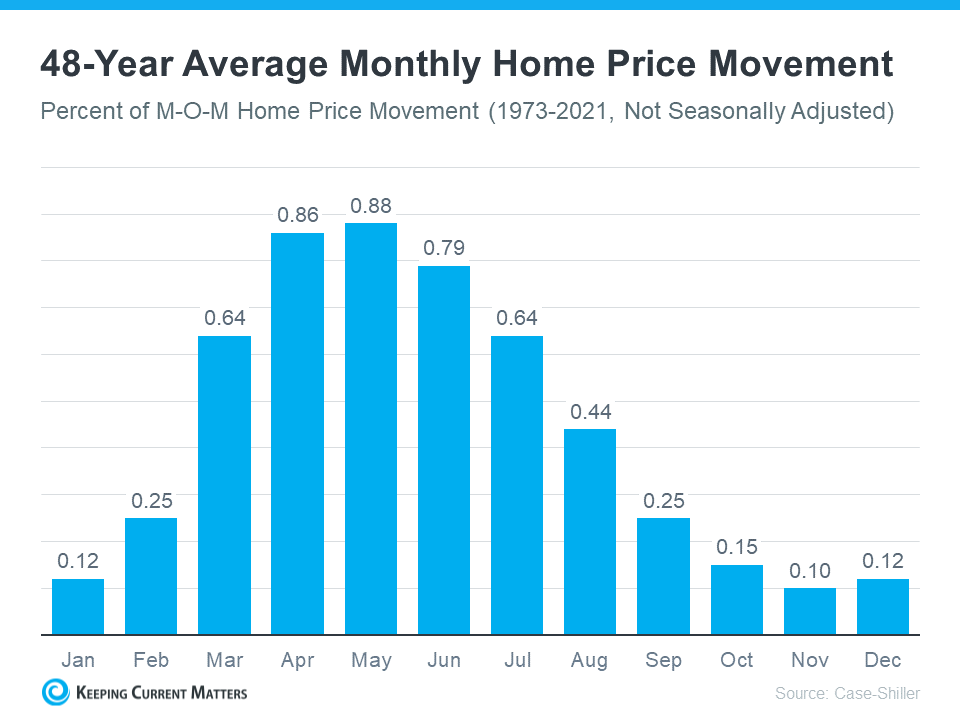
As the data from the last 48 years shows, at the beginning of the year, home prices grow, but not as much as they do entering the spring and summer markets. That’s because the market is less active in January and February since fewer people move in the cooler months. As the market transitions into the peak homebuying season in the spring, activity ramps up, and home prices go up a lot more in response. Then, as fall and winter approach, activity eases again. Price growth slows, but still typically appreciates.
Why This Is So Important to Understand
In the coming months, as the housing market moves further into a more predictable seasonal rhythm, you’re going to see even more headlines that either get what’s happening with home prices wrong or, at the very least, are misleading. Those headlines might use a number of price terms, like:
- Appreciation: when prices increase.
- Deceleration of appreciation: when prices continue to appreciate, but at a slower or more moderate pace.
- Depreciation: when prices decrease.
They’re going to mistake the slowing home price growth (deceleration of appreciation) that’s typical of market seasonality in the fall and winter and think prices are falling (depreciation). Don’t let those headlines confuse you or spark fear. Instead, remember it’s normal to see a deceleration of appreciation, slowing home price growth, as the months go by.
Bottom Line
If you have questions about what’s happening with home prices in your area, connect with CA Real Estate Group. Call Christine Almarines at (714) 476-4637.
Jul 21, 2023
Pull your calendars out and plan a picnic, get your lawn chairs ready, and get ready to head to your local park. Plus, guess what? Almost all the Orange County summer concerts are FREE!
Here are two sites that have compiled a list of all the summer concerts by respective Cities. They provide links to the actual event and/or City websites that provide complete info.
Orange County Free Summer Concerts, Movies & Shakespeare in the Park
Free Orange County Concerts in the Park 2023
Grab a picnic basket and some friends and dance your way to one tonight!!!
https://www.carealestategroup.com/monthly-newsletters/july-2023-newsletter/
Summer brings warmer nights and the yearning to linger outdoors. But once the sun goes down, your patio or deck requires special lighting to make it as inviting as the inside of your home. Here are six easy ways you can transform your patio or deck lighting. You might never want to go back inside again.
The Laguna Beach 2023 Pageant of the Masters Theme is ART COLONY: IN THE COMPANY OF ARTISTS.
This theme acknowledges the deep connections of the Festival and Pageant to the early artists who settled in Laguna Beach. It will also feature other memorable stories of artists assisting one another through cooperation and fellowship in vastly different eras and circumstances around the world..
This one-of-a-kind theatrical event, featuring live narration and original music performed live by the Pageant’s orchestra, takes place in the beautiful Irvine Bowl on the grounds of Laguna’s Festival of Arts July 7-September 1, 2023, every evening starting at 8:30 p.m.
Pageant of the Masters is at the Festival of Arts in Laguna Beach.
Two Shows for the Price of One!
Don’t forget your Pageant ticket gives you unlimited access to the Festival of Arts Fine Art Show all summer long. Come early and listen to some great music, get a glass of wine, see and purchase some fabulous art.
You can Purchase Pageant of the Masters Tickets Online or at The Festival Box Office
Celebrity Benefit Saturday August 26, 2023
Festival of Arts Raffle Information Is Online
All summer long, Festival of Arts and Pageant of the Masters guests have the opportunity to purchase raffle tickets for the chance to win a brand new 2024 C40 Recharge Twin Ultimate (approximate retail value $$63,000)! On Saturday, August 26, 2023, the lucky winning ticket will be pulled. Tickets are sold for $5 each or 5 tickets for $20.
Festival of the Arts Pageant of the Masters Dining
- Terra Laguna Beach: Sit-down restaurant and full bar available. To make a reservation, visit OpenTable or call (800) 491-4720.
- Intermission By Terra: Casual walk-up window ordering. Food, desserts, coffee and espresso bar. Dine on the Patio or the Festival Green
- Terra Wine Bar: Walk-up counter located near Festival Green. Open during Pageant of the Masters intermission.
Laguna Beach Pageant of the Masters Parking
The Festival of the Arts Pageant of the Masters is located at 650 Laguna Canyon Road.
Laguna Beach Parking Guide Is Online
Laguna Beach Free Summer Trolleys to Pageant of the Masters
The Festival of the Arts is a 5-10 minute walk from downtown Laguna, Main Beach and the other Laguna Beach art festivals.
keepingcurrentmatters.com | May 25, 2023
If you’re trying to decide if now’s the time to sell your house, here’s what you should know. The limited number of homes available right now gives you a big advantage. That’s because there are more buyers out there than there are homes for sale. And, with so few homes on the market, buyers will have fewer options, so you set yourself up to get the most eyes possible on your house.
Here’s what industry experts are saying about why selling now has its benefits:
Lawrence Yun, Chief Economist at the National Association of Realtors (NAR):
“Inventory levels are still at historic lows. Consequently, multiple offers are returning on a good number of properties.”
Selma Hepp, Chief Economist at CoreLogic:
“We have not seen the traditional uptick in new listings from existing homeowners, so undersupply of housing will continue to heighten market competition and put pressure on prices in most regions. Some markets are already heating up considerably, but price premiums that we saw last spring and summer are unlikely.”
Clare Trapasso, Executive News Editor at Realtor.com:
“Well-priced, move-in ready homes with curb appeal in desirable areas are still receiving multiple offers and selling for over the asking price in many parts of the country . . .”
Jeff Tucker, Senior Economist at Zillow:
“. . . sellers who price and market their home competitively shouldn’t have a problem finding a buyer.”
Bottom Line
If you’re thinking about selling your house, connect us at CA Real Estate Group and we can share the expert insights you need to make the best possible move today. Call Christine Almarines at 714-476-4637.
When it comes to keeping known hazards out of your home, you probably already have a good idea about the things that you need to get rid of — like that stack of junk mail sitting on your steps that has the potential to become a tripping hazard — but did you know there are other surprise dangers hiding in your home?
No matter whether you rent or own, you should be keeping an eye on these eight hidden dangers and tossing them as soon as they become problematic.
It’s never good to keep known toxins in or around your home, which is why Kevin Geick, manager of Bio Recovery, says you should dispose of hazardous materials such as old paint cans, pesticides, cleaning chemicals, or batteries following local regulations as soon as you’re done with them.
“Many communities have designated drop-off points for hazardous waste,” he adds. “These materials pose potential risks to the environment and human health if not disposed of properly, so it’s important to discard them as soon as possible to prevent accidents or contamination.”
Fire extinguishers are essential safety devices, but many people overlook the fact that they come with an expiration date, shares Karina Toner, operations manager at Spekless Cleaning. “Expired fire extinguishers might not work effectively during an emergency, which would put lives and property at risk,” she says. “It’s crucial to regularly check the expiration dates and replace or recharge them accordingly.”
Expired Food and Pantry Items
You may already know that it might not be a good idea to eat food that has gone way past its expiration date and shows signs of spoilage, but did you know it can be harmful to even have those items hanging out in your fridge or pantry? That’s why Geick says it’s so important to regularly check your pantry and refrigerator for expired or spoiled food.
“Discard any items that have passed their expiration dates or show signs of spoilage,” he says. “These items can harbor harmful bacteria or toxins, leading to foodborne illnesses, so it’s crucial to discard them promptly to maintain a safe and hygienic environment in your home.”
Expired Household Chemicals
Believe it or not, household chemicals such as bleach, ammonia, and drain cleaners can pose serious health and safety risks if mishandled, stored improperly, or kept past their “good by” date.
“People often forget about partially used containers or overlook the expiration dates,” Toner says. “These chemicals can lose their effectiveness or become unstable over time, leading to potential accidents or chemical reactions.” You should safely dispose of expired or unused chemicals at designated collection centers or hazardous waste facilities.
Parents, especially parents with multiple children or kids with large age gaps, know just how easy it is to accumulate baby products like car seats, strollers, and cribs. “However, safety standards and regulations for these items evolve, and older products might not meet the latest safety requirements,” according to Toner. “It’s crucial to stay informed about product recalls and dispose of outdated or recalled baby items properly to ensure the safety of infants and young children.”
Broken or Chipped Dishware
Angela Lee, a content writer for Hellamaid, says holding onto coffee mugs or dishware with cracks or chips in them is just a disaster waiting to happen. Not only do you run a risk of getting cut on the sharp edges of these pieces, but you’re exposing yourself to an additional risk of being burned or badly injured if your dish fails while you’re using it.
Perhaps even more concerning, you may be unknowingly exposing yourself to bacteria and mold by using these pieces. “The cracks and crevices in chipped or cracked items can harbor bacteria, especially in porous materials like ceramics,” she says. “Even with thorough washing, it can be challenging to remove all the bacteria from the damaged areas. This can potentially lead to contamination and increase the risk of foodborne illnesses.”
Keeping your favorite lipsticks, eyeliners, and mascaras in the rotation past their shelf life can have dire consequences, according to Rocky Vuony, founder and director of Calibre Cleaning. “Over time, these can harbor bacteria, leading to skin infections,” he says. “Dispose of any items past their [expiration] date.”
Air vents and ducts accumulate dust, pet dander, and other allergens, which Muffetta Krueger, cleaning expert and founder of Muffetta’s Domestic Assistants, says can affect indoor air quality. “Regularly cleaning and maintaining these areas can improve airflow, minimize allergens, and enhance the overall indoor environment.”
The frequency of cleaning air vents and ducts depends on various factors, according to Krueger, including the environment, the presence of pets, and the overall air quality. “As a general guideline, it’s recommended to have your air vents and ducts professionally cleaned every three to five years. However, if you notice excessive dust buildup, mold growth, or experience worsened indoor air quality, it’s advisable to have them cleaned sooner.”